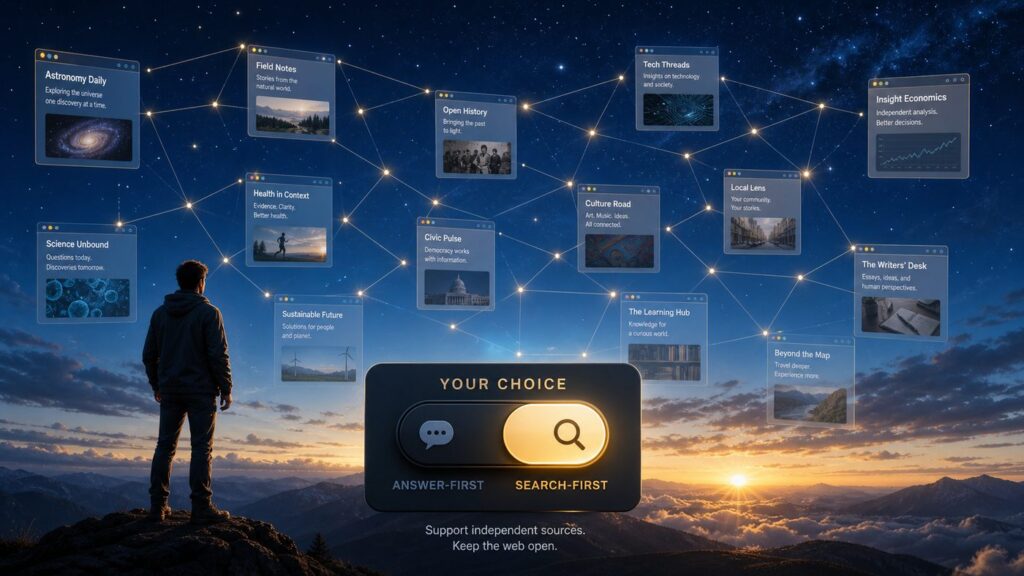
The searchless internet: when AI answers replace search
The answer comes first, the source comes second, and the scammers have noticed
In short: we still come online to search, but more and more often AI answers before we reach a single source. That saves time on simple questions. It also means fewer people check where an answer comes from, fewer visits for the people who wrote the original material, and a new opening for scammers, who have learned to plant false information where AI will pick it up. You do not have to give AI up. You do need to know when to switch it off and open the sources yourself.
Table of Contents
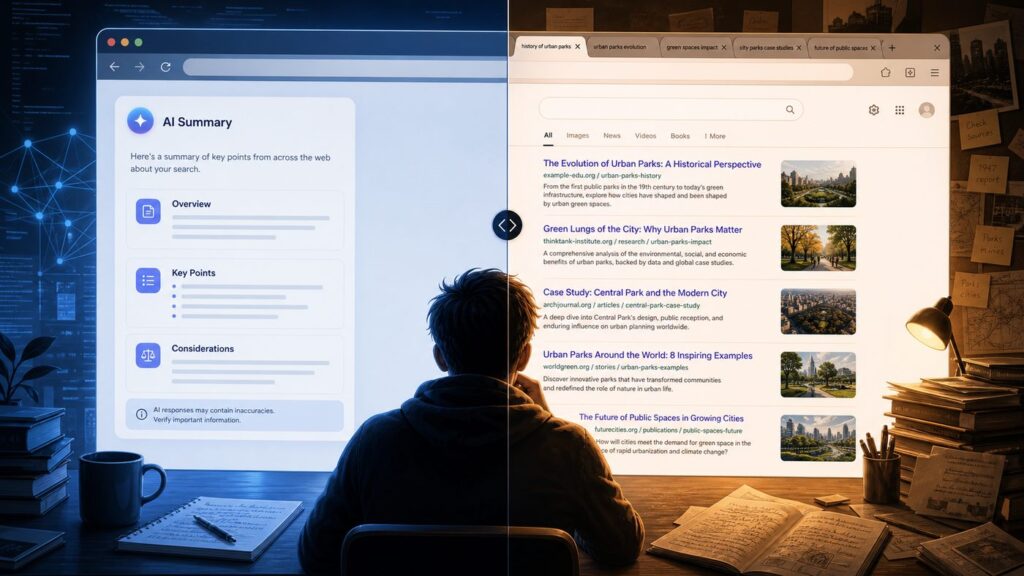
AI convenience and web discovery now compete in the same interface.
What is the searchless internet
The searchless internet is not an internet without search engines. It is a change in what happens after you type a question.
You type a query.
AI writes a finished answer at the top of the page.
The answer is often good enough, so you stop there.
The websites the answer was built from get less attention and fewer visits.
The web still exists in this model, but mostly as raw material. Human attention stays in the answer layer.
When that becomes the standard, the open web does not vanish overnight. It thins out: fewer clicks, weaker reasons to publish, less original work, fewer different sources and, in the end, worse answers.
What's new in 2026
Clicks roughly halve when an AI summary appears. Pew Research tracked real browsing and found that people clicked a search result in 8% of visits when an AI summary was shown, compared with 15% without one. Only about 1% clicked a source inside the summary.
A controlled experiment confirmed it. A field study published in April 2026 with more than 1,000 Chrome users found that clicks to websites fell by 39.8% when an AI Overview was shown, and searches that ended without any click rose by 34.5%.
News sites feel it most. The Reuters Institute, using Chartbeat data from more than 2,500 news sites, reported that traffic from Google search fell 33% worldwide between November 2024 and November 2025. Small publishers lost the most.
Regulators stepped in. The European Commission opened a formal investigation in December 2025 into how Google uses publishers’ content for its AI answers. In June 2026 the UK competition authority told Google to give publishers a way to keep their material out of AI features, and Google announced an opt-out control.
Browsers started adding an off switch. Firefox 148 introduced a single setting, AI controls, that blocks the browser’s AI features in one step.
Scammers moved into the answer box. In March 2026, reporting by Wired showed fake customer support numbers appearing in AI answers. Scammers post the numbers on small websites and forums next to a big company’s name, and the AI repeats them as if they were official.
Why this matters for your safety
An AI answer sounds sure of itself whether it is right or wrong. That is exactly what a scammer needs.
One voice instead of many. A list of results lets you compare. A single answer asks you to trust.
A confident tone is not proof. The answer does not show how uncertain the sources were.
A phone number in an AI answer is not verified. If you call a planted number, you reach a scammer who sounds like customer support. That is how many scam calls start today.
The same goes for links, download pages and “official” apps. For anything that involves money, accounts or health, open the company’s own website yourself.
The habit that protects you from phishing protects you here too: do not act on the first thing you are shown. Check it at the source.
Why this matters for creators
For creators, less discovery is not only a traffic problem. It is a survival problem.
Independent writers, journalists, teachers and niche experts depend on a simple loop.
They publish useful work.
People find it through search.
They earn trust, readers, subscribers or clients.
They put that back into better work.
Answer-first AI can break the loop. Even when a source is cited, the reader may never visit it. Credit without a click is visibility without a living.
This is not only about money. When careful research stops paying, the web fills with recycled summaries instead of first-hand reporting, testing and expertise. And weaker sources mean weaker AI answers later.
From search to synthesis
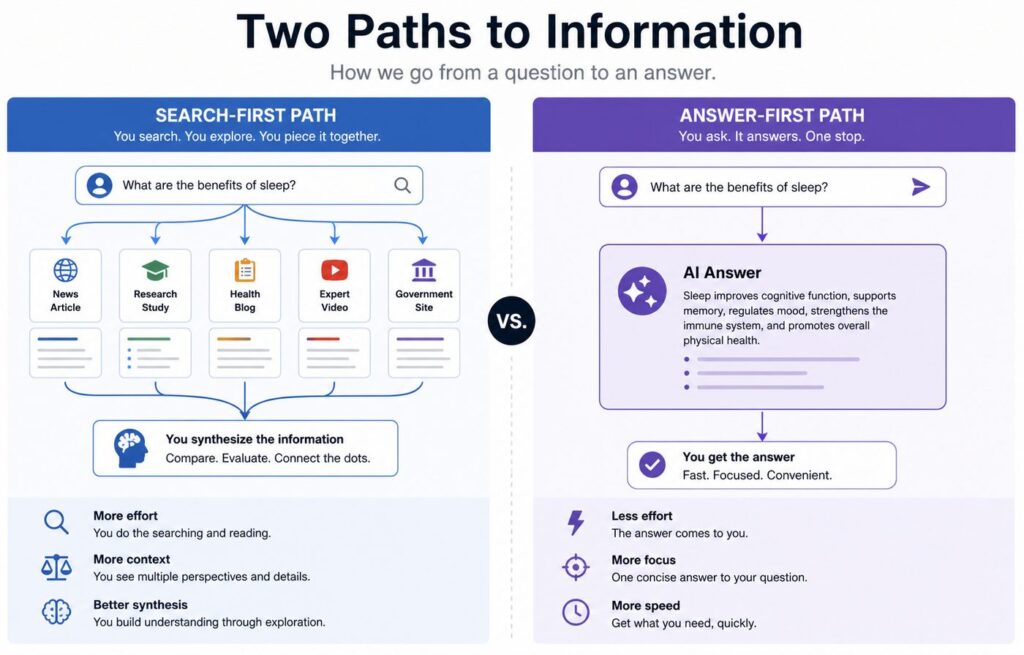
Search-first and answer-first systems lead people to very different behaviour.
Traditional search gave you options first. You could scan the headlines, compare points of view and choose where to go.
Answer-first systems reverse the order: the conclusion first, the options second. That changes behaviour in quiet ways.
Less reading across several sources.
Less checking of who is behind a claim.
More trust in one written-up story.
More dependence on ranking choices you cannot see.
For low-stakes questions, that is fine. For health, money, security, legal matters and politics, it is a risk. When the summary runs ahead of the checking, confidence can be higher than accuracy.
How to switch AI answers off
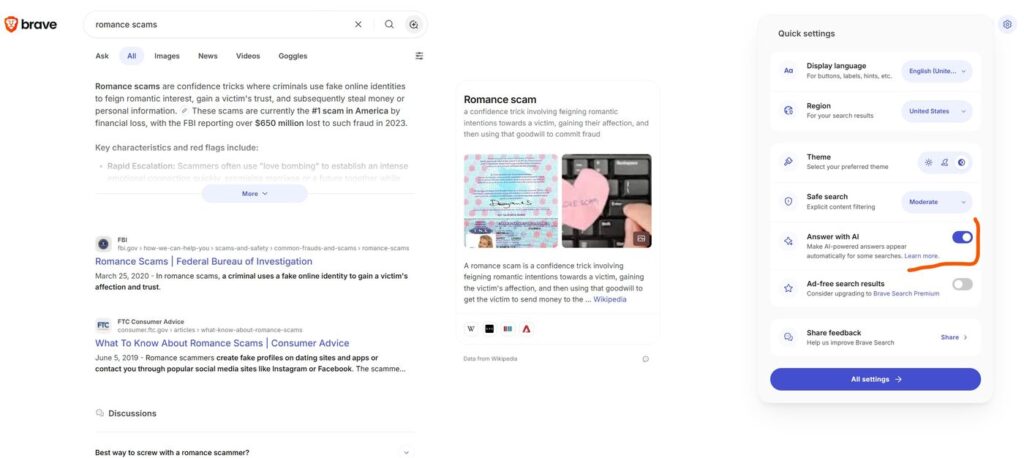
The “Answer with AI” switch in the quick settings of Brave Search.
A switch does not reject AI. It lets you decide when AI leads and when the sources lead. Settings change often, so treat this as a snapshot from October 2026.
Google. There is no full off switch for AI Overviews. After you search, choose the Web filter (under “More”) to see only links. You can make this permanent by adding a custom search engine in your browser with the address https://www.google.com/search?q=%s&udm=14.
Firefox. Open the menu, go to Settings, then AI controls, and turn on Block AI Enhancements. Mozilla says the choice also applies to AI features added later.
Brave Search. Click the gear icon and turn off Answer with AI. In the Brave browser you can also enable the Anti-AI search filters under Shields, Content Filtering.
DuckDuckGo. Start your searches at noai.duckduckgo.com, or turn the AI features off in Settings.
Think of it as two modes, not two camps.
Answer mode: a quick overview, brainstorming, simple tasks.
Search mode: finding sources, checking facts, comparing views, anything where a mistake costs you.
What good AI switch design looks like
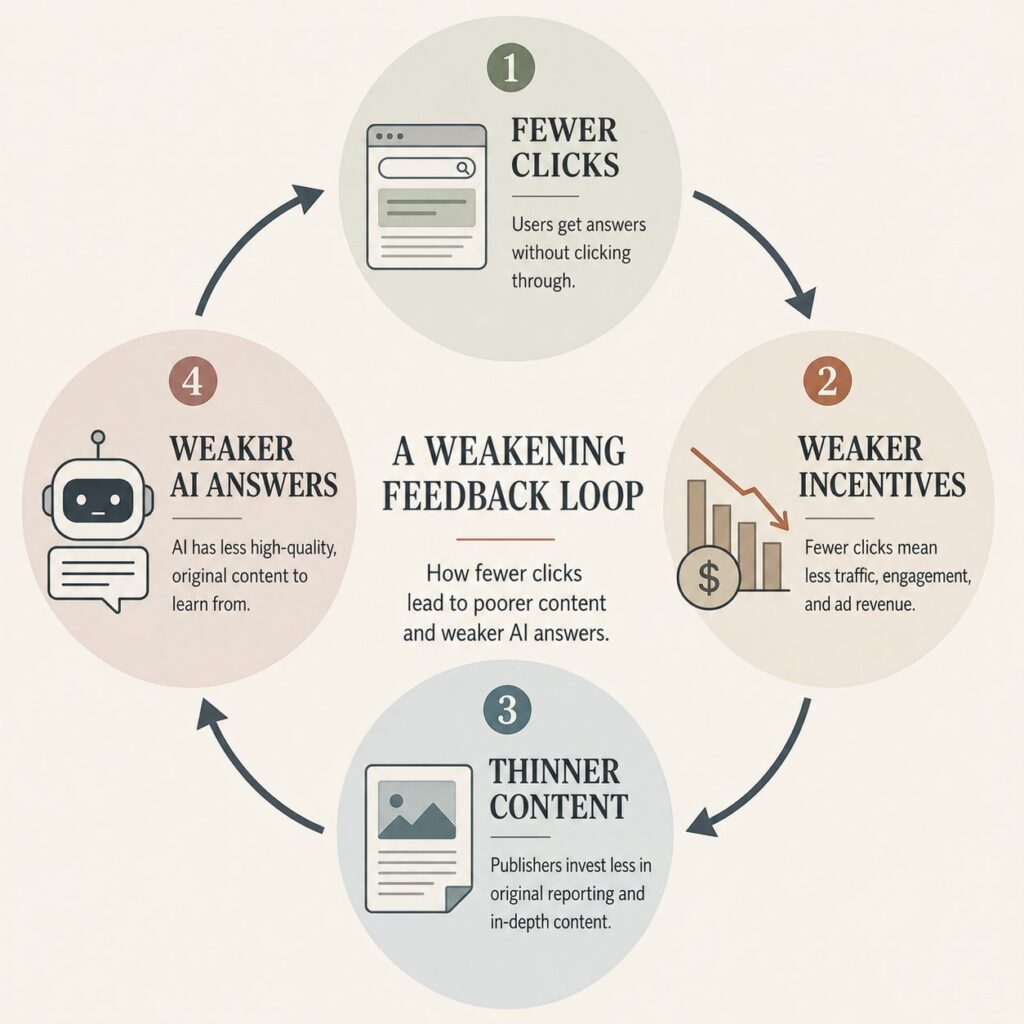
A shrinking loop can weaken creators, sources and, in time, the answers themselves.
If browsers and search products want a healthy web, the controls should be clear, visible and easy to undo.
The choice should be obvious. You should always know whether you are looking at an AI answer or at search results.
Switching should take one click. No hidden menus and no “are you sure” loops.
Sources should be easy to open. Citations are not decoration. The design should invite you to visit them.
Uncertainty should be shown. If sources disagree, the answer should say so.
Credit should bring visits. When someone is researching, the design should send them to the people who did the work.
What you can do now
Checking habits keep the quality of information, and the people behind it, alive.
Use AI answers as a starting point, not as the end of the road.
Open at least two original sources for anything important.
Switch to search mode when accuracy matters.
Never take a phone number, a payment link or a download from an AI answer without checking it on the official website.
Treat confident wording as a guess to be tested, not as proof.
Support the creators you trust with your visits, subscriptions and shares.
Who controls discovery
It is tempting to make this a question of “AI good” or “AI bad”. The real question is who designs the path between your question and the answer.
Who decides which sources you get to see.
How default settings shape the behaviour of millions of people.
Whether creators can still be found, and so can still afford to publish.
Whether you can still reach a web with many voices that you can inspect yourself.
If fewer people visit source websites, fewer people have a reason to produce careful, original information. Over time that leaves AI systems with thinner, older and weaker material. Fewer visits lead to less publishing, weaker sources, weaker answers and even fewer reasons to leave the answer box.
Final thought
The goal is not less AI. The goal is real choice and a web worth discovering.
The internet does not become searchless in one product launch. It gets there through thousands of small design decisions that quietly replace exploring with concluding.
AI answers are here to stay, and they should be. They are useful, fast and often impressive. But if answer-first becomes the only practical mode, creators lose discovery, sources thin out and the open web gets weaker every year.
The way forward is not against AI. It is for choice.
Visible switches in browsers and search engines.
Easy movement between answer mode and search mode.
Design that rewards visiting the source.
Keep AI. Keep search. Keep the web worth writing for.
Frequently asked questions
What is the searchless internet?
It is a way of using the internet in which AI gives you a finished answer before you see any website. You still ask questions, but you visit far fewer of the sources that the answer was built from.
Can I turn off AI Overviews in Google?
Not completely. Google does not offer a full off switch. You can use the Web filter after each search, or set a custom search engine with the udm=14 parameter so that you see only links.
Are AI answers safe to rely on?
For simple, low-stakes questions they are usually fine. For money, health, security and legal topics, open the original sources. AI answers can repeat false information, including fake customer support numbers planted by scammers.
How do scammers use AI answers?
They publish false details, such as a phone number, next to a well-known company’s name on small websites and forums. The AI collects them and shows them as an answer. People who call reach a scammer posing as support.
Does this affect small websites and creators?
Yes. When an AI summary appears, people click through to websites about half as often. Small publishers and independent creators, who depend on being found through search, lose the most.
Reuters Institute, Journalism, Media and Technology Trends and Predictions 2026 (Chartbeat traffic data)
SSRN field experiment on AI Overviews and outbound clicks, April 2026
Wired and Security Boulevard, March 2026: scam phone numbers in AI Overviews
European Commission, antitrust investigation into Google’s use of content for AI, December 2025
About the author
Brîndușa Maria, Senior Software Test Analyst, ISTQB® Certified Tester Advanced Level Test Analyst (CTAL-TA). I write about how to recognize online scams. LinkedIn
Note: this article is based on my research and professional experience. I used artificial intelligence tools for drafting and editing.
📢 Share the knowledge, stay safe! 🔒✨ Use the share buttons below and help others stay safe online. The more we know about online scams, the better protected we are! 🚀💙