
Follow the money, then ask for the numbers
In short: most people who join a multi-level marketing (MLM) business lose money, and the materials that recruit them rarely show the numbers that would reveal it. The model now sells resellable courses and digital files and often poses as a job offer on social media. A real job pays you; an MLM asks you to pay first. Before joining, ask for the median income, the full costs and the share of people who lose money.
Table of Contents
Multi-level marketing (MLM) pitches are everywhere: in your feed, in your DMs, in job groups, behind polished “digital business” storefronts. And they all share the same tone: moral, motivational, empowering. Be your own boss. Build something honest. The products speak for themselves.
That tone is exactly why these offers deserve a closer look. The image the industry projects and the picture documented in the scientific literature are very different, and the gap between them is where people lose money.
This is no longer just about supplements and lotions. The same recruitment model now sells online courses, “masterclasses” and resellable digital files through slick link-in-bio storefronts, and it increasingly disguises itself as a job offer in your social media feed.
This article is not about attacking any specific person. It puts the industry’s marketing next to the published research and to public regulatory actions, so you can make an informed decision if an “opportunity” ever lands in your inbox.
How MLM sells itself
Across companies, products and decades, MLM recruitment leans on the same core promises:
- Honesty and authenticity. “This is not a scheme: real products, real people, real results.” The pitch presents itself as the transparent alternative to corporate marketing.
- Low risk, high flexibility. Work from your phone, a few hours a week, no experience needed.
- Proven success. Testimonials, income screenshots, cars and travel, presented as the normal outcome, available to anyone willing to work.
- Community and purpose. You are not joining a sales force; you are joining a family, a movement, a better life.
Taken at face value, these promises make two testable predictions:
- If the business is as honest as advertised, its materials should be full of real statistics about income, costs and failure rates.
- If the opportunity is genuinely good, giving prospects complete, accurate information should make it more attractive, not less.
Both predictions have been tested by researchers. Here is what they found.
Not just lotions anymore: MLM's digital facelift
When most people hear “MLM”, they picture physical products: cosmetics, supplements, kitchenware. But the model has had a digital facelift, and the new version is harder to recognize. The product is now often information itself:
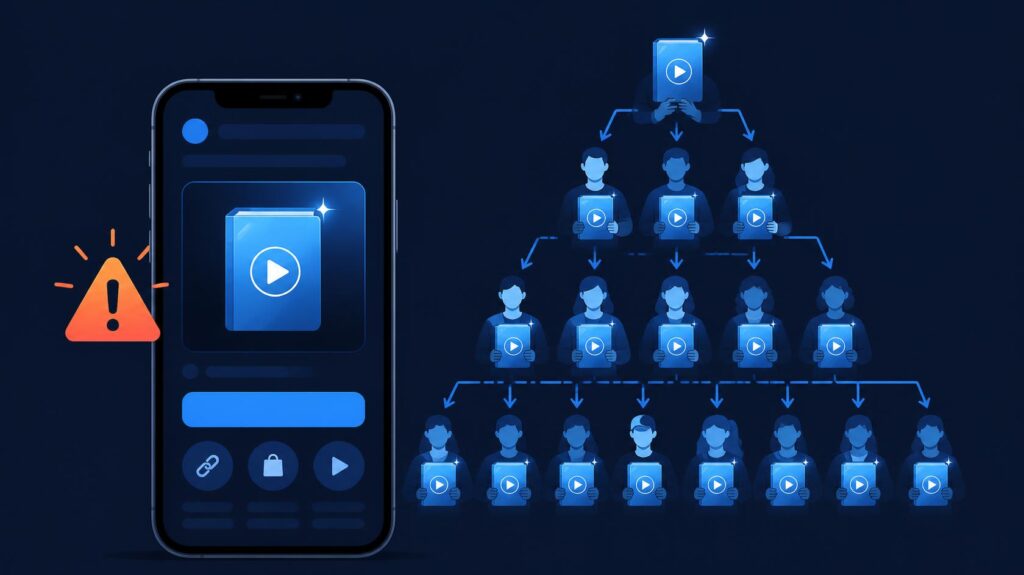
- Resellable courses. You buy a “digital marketing” or “master resell rights” course, and the main thing the course teaches you is how to resell that same course to others. The person who recruited you earns from your purchase, and you earn by recruiting the next buyer. That is the MLM mechanic with the product reduced to a pretext.
- “Faceless” digital products. Templates, planners, e-books and “done-for-you” file bundles promoted with the promise of passive income, where the real money is made selling the dream of selling to the next wave of buyers.
- Link-in-bio storefronts. Platforms like Stan Store, Beacons or Gumroad are legitimate tools used by many honest creators. But their polished checkout pages also give recruitment-driven schemes a professional look: one link, one glowing income screenshot, one “start today” button.
The one question to ask about any digital “business package”: can I earn anything from this package if I never resell it? If the honest answer is no, because the course only teaches you to sell the same course and the files have no value to a real customer, then you are not buying a product. You are buying a place in the recruitment chain.
The packaging changed; the structure did not. Whenever the main way to make money is recruiting the next participant rather than selling something of standalone value to a real end customer, you are looking at the same pyramid-shaped income distribution the research describes, with no warehouse required.
The digital version even removes the old natural brake: physical inventory cost money to produce, so there was a limit somewhere. A resellable PDF costs nothing to copy, which means the only thing being sold, at scale, is the opportunity itself.
What the research actually shows
The paper “Multi-Level Lies” by Alexandra J. Roberts, published in the UC Davis Law Review in 2025, is based on a survey of more than 200 MLM sellers and on the seller agreements of 167 MLM companies. It concludes that the industry is marked by deceptive claims about both income and products:
- Sellers are recruited with deceptive claims about how much they can earn and how much effort it takes.
- End customers are told misleading things about what the products can do.
- Misleading claims are not an occasional bad-apple problem: they are a structural feature of how the industry promotes itself.
The best known figure comes from a different source: a study of 350 MLM companies by consumer researcher Jon M. Taylor, published on the website of the US Federal Trade Commission (FTC), which found that at least 99% of participants lose money.
In other words, the dominant practice documented in the literature is not honesty and transparency. It is closer to the opposite.
What's new in 2026
- Amway pays $225 million (September 2026). The FTC alleged that Amway and two affiliated training organizations promised recruits “substantial income, exceeding $40,000 a year”, while most people who joined after 2020 spent more on Amway products and training than they earned from Amway. It is the largest amount the FTC has ever recovered from an MLM.
- Top sellers are now held responsible too (April 2026). The FTC acted against Stormy Wellington, a top recruiter for Total Life Changes and Farmasi, who promised followers on YouTube and social media six and seven figure incomes and “60 new millionaires in 2026”. The companies’ own data told a different story: in 2023, 76.8% of active Total Life Changes participants earned nothing and only 0.4% earned more than $5,000.
The income screenshot in your feed is a marketing claim, and in 2026 regulators started treating it like one.
Full information makes the offer less attractive
Here is where the industry’s self-image runs into its biggest problem.
A 2026 study by Evans, Wojdynski and Xiang in the Journal of Consumer Policy shows that adding clear, specific disclaimers about real earnings significantly lowers people’s expectations about MLM income.
Put plainly: when people receive complete and transparent information, interest in the opportunity goes down.
If these were genuinely good opportunities, telling prospects the full truth would win them over. Instead, controlled studies show that accurate information makes the offer less attractive, which explains a great deal about why it is so rarely provided in full.
The information that goes missing
A third study, by Bosley and colleagues in the Journal of Public Policy and Marketing (2026), reviewed more than 2,000 MLM marketing posts with income or lifestyle claims. The vast majority had no earnings disclaimer at all, and none of the disclaimers that did exist fully met the industry’s own self-regulatory guidance.
What tends to be missing:
- The median distributor income, not the exceptional earnings at the top of the pyramid.
- Mandatory expenses: inventory, subscriptions, events, training packages.
- The real time invested to achieve the earnings shown.
- The percentage of participants who lose money.
The fake "job offers" flooding social networks
There is one place where the gap between the industry’s honest self-image and actual practice is most visible right now: the recruitment posts spamming every social network.
You have seen them. “We’re hiring!” “Remote position, flexible hours, no experience needed.” “Looking for 5 motivated people, DM me.” “Mom of two, fired my boss, now I work from my phone.” They appear in job groups, under unrelated posts, in your DMs, on TikTok and Instagram, formatted exactly like job listings.
Let us be completely clear about something these posts never say:
Being recruited into an MLM is not a job.
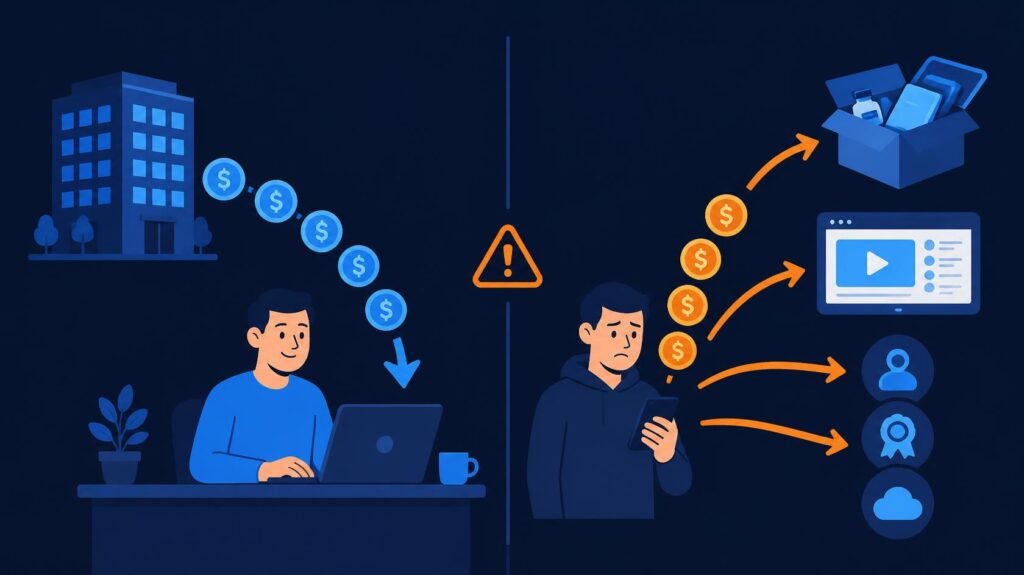
A job and an MLM position are opposites on the point that matters most, the direction the money flows:
- A job pays you: a salary or wage, from day one, with an employment contract, whether or not the company had a good month.
- An MLM asks you to pay: a starter kit, a course, a monthly product quota, event tickets, a “business package”, before you have earned anything. Your income depends on what you sell and, above all, on whom you recruit.
Calling MLM recruitment a “job opening” is not creative marketing. It is a false claim aimed at people searching for work, often in a financially vulnerable moment, which makes it more harmful, not less.
How to recognize the pattern in seconds:
- The “job” is never named. No role, no company, no responsibilities: just “an opportunity” revealed only in private messages.
- You have to pay something to start: a kit, a course, a subscription, a minimum order.
- The income shown is lifestyle, not payroll: screenshots, cars, beach laptops, never a contract or a salary figure.
- The recruiter’s enthusiasm is about the team you will build, not the work you will do.
- Vague titles do the heavy lifting: “brand partner”, “independent business owner”, “digital entrepreneur”.
If a listing shows any of these signs, you are not being hired. You are being sold to. Moving the conversation into private messages is the same move phishing scammers use; read more in our phishing guide.
A simple test for any "opportunity"
You do not need an academic background to test an MLM pitch yourself. If the business were as transparent as it claims, its presentation would open with:
- the official income disclosure statement of the company;
- the median income across all distributors;
- a full list of required costs;
- the share of participants who end the year with a loss;
- for digital packages and courses: what you can earn from the package without reselling it.
The research shows the reality is exactly the reverse: this information is almost always absent from recruitment materials, buried in fine print, or replaced with success stories that represent a tiny fraction of participants. The same goes for the “profit” screenshots used by fake trading platforms.
What real transparency looks like
It is not enough to say a business is honest. Real transparency means also presenting the information that makes the offer less attractive:
- median income;
- expenses;
- time invested;
- the percentage of people who lose money.
Only with all of that on the table can someone make an informed decision.
Before joining any MLM, ask for three documents: the company’s official income disclosure statement, the median distributor income, and the percentage of participants who lose money. If the answer is a story instead of numbers, you already have your answer.
Conclusion
The MLM industry markets itself as honest, transparent and open to anyone. The scientific literature does not support that image, neither as the dominant practice in the industry, nor as an explanation for its success.
The published evidence points the other way: an industry marked by misleading income and product claims, prospects whose interest drops when they are given accurate information, and recruitment materials that systematically omit the numbers that matter most.
The model keeps updating its costume: from supplements to resellable courses and digital “business packages”, from home parties to link-in-bio storefronts, from “join my team” to fake job listings. The structure underneath is the same, and so is the test: follow the direction the money flows, and ask for the numbers.
Transparency is not a slogan. It is a set of numbers, and you have the right to see them before you sign anything.
Frequently asked questions
Is every MLM a scam?
Not every MLM is illegal, and this article does not claim that. The point is narrower: the research does not support the honest, transparent image the industry projects, and the earnings data show that the overwhelming majority of participants do not profit.
Where does the “99% lose money” figure come from?
From a study of 350 MLM companies by consumer researcher Jon M. Taylor, published on the FTC website. The companies’ own disclosures point the same way: in 2023, 76.8% of active Total Life Changes participants earned nothing, according to the FTC.
If a distributor genuinely believes what they say, is it still misleading?
Sincerity does not make a claim accurate. Many distributors repeat income and product claims in good faith because that is what they were told. The research focuses on the effect on consumers: incomplete information leads to inflated expectations, regardless of the speaker’s intent.
Is it still an MLM if there is no physical product, just a course or digital files?
Yes, and it can be worse. When the “product” is a resellable course or a bundle of digital files, and the main way to earn is convincing others to buy in so they can resell it too, the structure is the same recruitment-driven pyramid, with even lower product value, since a digital file costs nothing to copy. The platform used to sell it does not make the underlying model legitimate.
I saw a “work from home” job post and the recruiter turned out to be from an MLM. Is that normal?
It is common, but it is not honest. A job pays you a wage under a contract; an MLM asks you to pay to participate and makes your income depend on sales and recruitment. If a “position” requires you to buy anything to start, it is not employment.
Can I earn anything from a digital package if I do not resell it?
Ask this before you buy any course or “business package” sold through a link-in-bio storefront. If the only way to get your money back is to sell the same package to someone else, the product has no real value of its own and you are paying for a place in a recruitment chain.
What should I ask before joining any MLM?
Ask for the official income disclosure statement, the median distributor income, the full list of required costs, and the percentage of participants who lose money. A legitimate opportunity can answer with numbers. A story instead of numbers is a red flag.
More reads and trusted sources
- Roberts, A. J. (2025): Multi-Level Lies, UC Davis Law Review
- Evans, N. J., Wojdynski, B. and Xiang, H. (2026): Great Expectations: disclaimer specificity and MLM earnings estimates, Journal of Consumer Policy
- Bosley, S. A. et al. (2026): Earnings Claims and Disclaimers in Multi-Level Marketing, Journal of Public Policy and Marketing
- FTC: FTC Takes Historic Action Against Multilevel Marketing Operator Amway (September 2026)
- FTC: FTC Takes Action Against High-Level MLM Participant (April 2026)
- FTC: Multi-Level Marketing Businesses and Pyramid Schemes (consumer guidance)
- FTC: Business Guidance Concerning Multi-Level Marketing
About the author
Brîndușa Maria, Senior Software Test Analyst, ISTQB® Certified Tester Advanced Level Test Analyst (CTAL-TA). I write about how to recognize online scams. LinkedIn
Note: this article is based on my research and professional experience. I used artificial intelligence tools for drafting and editing.
📢 Share the knowledge, stay safe! 🔒✨ Use the share buttons below and help others stay safe online. The more we know about online scams, the better protected we are! 🚀💙

- July 4, 2026
- Brîndușa Maria
- 6:23 pm