
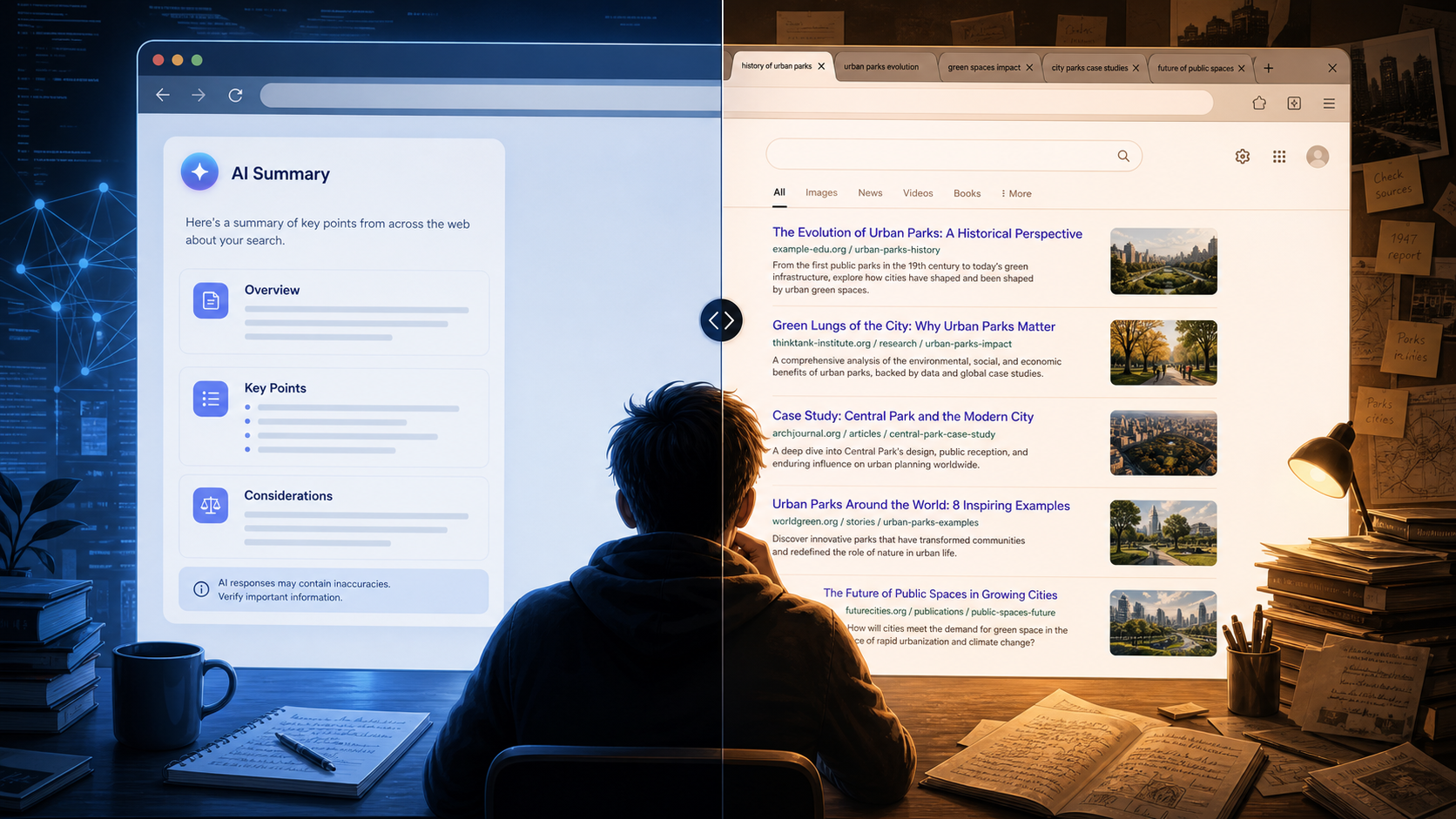
We still come online to search. We want context, comparison, and sources we can trust.
But the interface is changing fast. Instead of showing us a path through the web, modern AI search often gives us a finished narrative first. Clean summary. Confident tone. Fewer reasons to click.
This sounds like progress, and in many moments it is. Faster answers are genuinely useful. The problem starts when this answer-first model becomes the default for everything, and actual web discovery becomes optional behavior for power users.
That is the core tension behind what I call the searchless internet: people still ask questions, but fewer people visit the creators who produced the knowledge in the first place.
What is the “searchless internet”
The searchless internet is not “no search engine.” It is a shift in search behavior and search interface:
- Users type a query.
- AI generates a synthesized answer at the top.
- The user often gets enough value to stop there.
- Original sources receive less direct attention and fewer visits.
In this model, the web still exists, but mainly as retrieval infrastructure. Human attention stays in the answer layer.
When that becomes standard at scale, the open web does not disappear overnight. It degrades gradually: fewer clicks, weaker incentives, less original publishing, thinner source diversity, and eventually lower answer quality.
Why this matters for creators first

Let us make this concrete. Most creators, independent writers, journalists, educators, and niche experts rely on discoverability loops:
- Publish useful work.
- Get discovered through search.
- Earn trust, traffic, subscribers, leads, clients, or revenue.
- Reinvest in better work.
Answer-first AI can interrupt this loop. Even when a source is technically cited, the user may never visit it. Credit without click becomes visibility without viability.
And this is not only a revenue issue. It is a quality issue. When original creators cannot justify the effort of deep research, the web fills with recycled summaries instead of first-hand reporting, testing, and expertise.
No discovery means no durable creator economy. No creator economy means weaker source material for future AI answers.
From search to synthesis
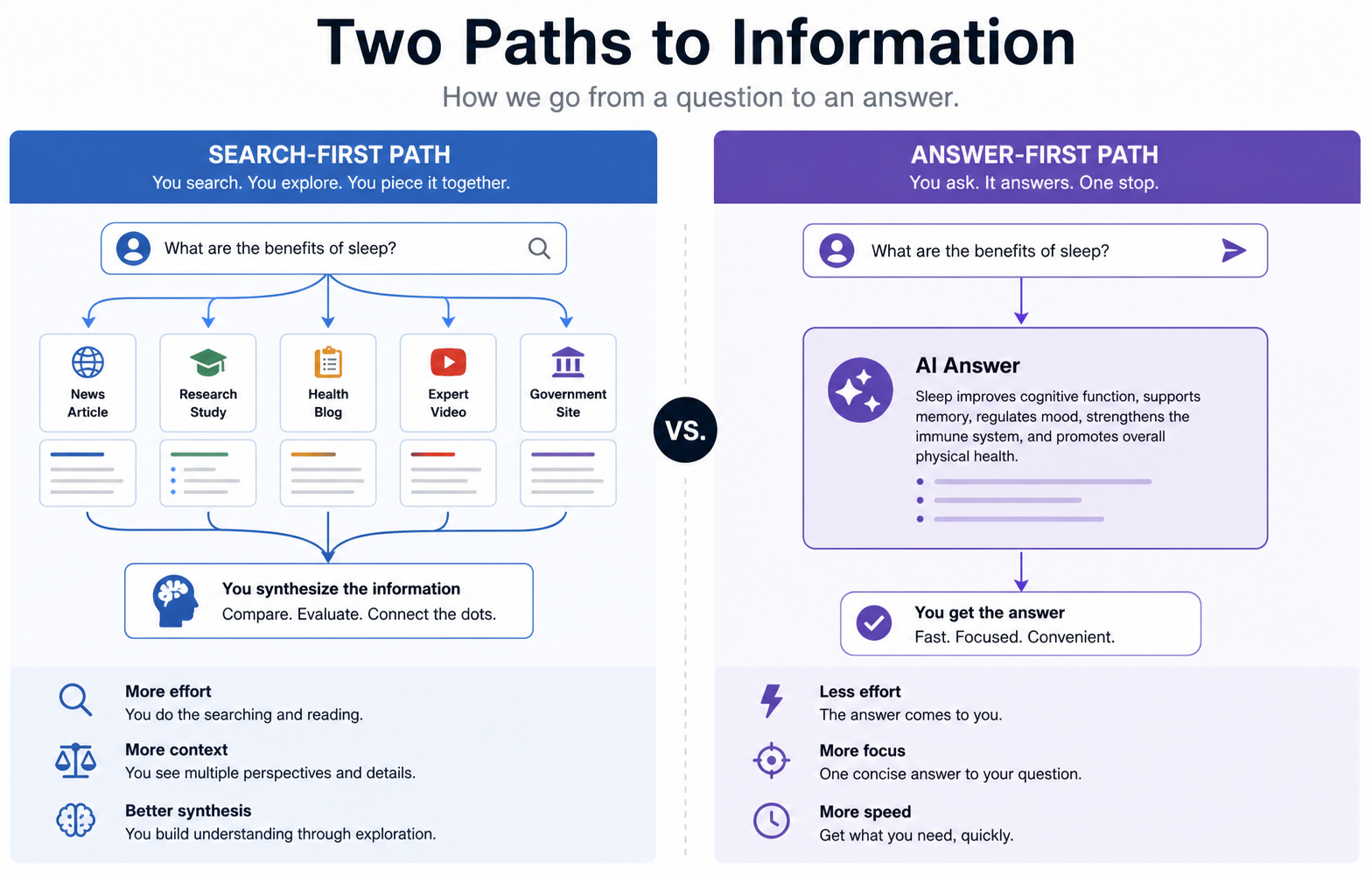
Traditional search gave users options first. You could scan headlines, compare perspectives, evaluate domain credibility, and choose your path.
AI answer-first systems reverse that order. They give conclusion first, options second.
That shift changes user behavior in subtle but powerful ways:
- Less lateral reading across multiple sources.
- Less source validation by non-experts.
- More trust in a single synthesized narrative.
- Higher dependence on ranking and retrieval choices users cannot see.
For low-stakes queries, this can be fine. For health, finance, security, legal, policy, and social topics, this can be risky. If synthesis outruns verification, confidence can exceed accuracy.
Why browser AI toggles matter
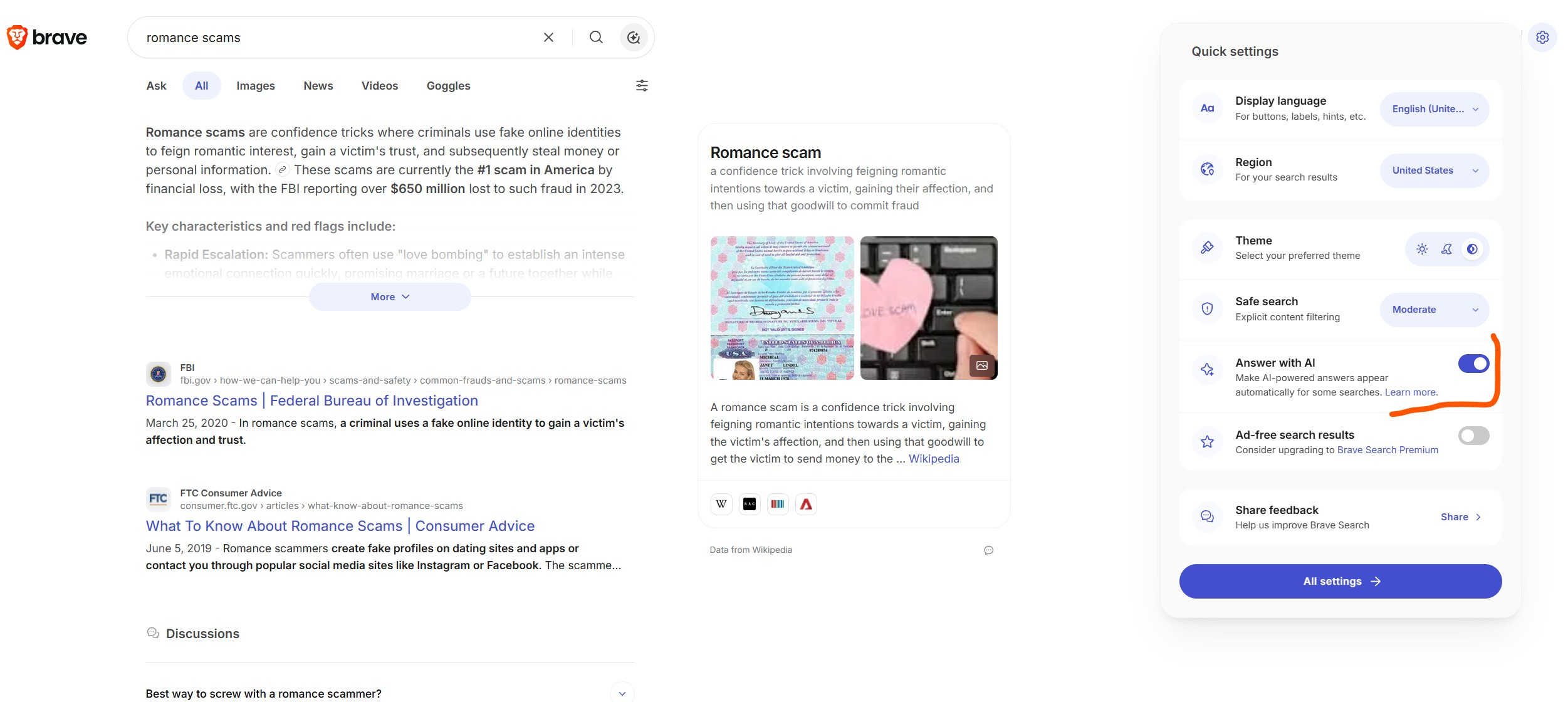
This is why the browser-level toggle idea matters so much.
An AI toggle does not reject AI. It gives control over when AI should lead and when direct search should lead. That is a meaningful difference.
Think of it as mode selection, not ideology:
- Answer mode: fast orientation, rough overview, brainstorming, simple tasks.
- Search mode: source discovery, creator exploration, verification, nuanced comparison.
When users can switch easily, we preserve both benefits: AI speed and open web depth.
When users cannot switch easily, convenience becomes enclosure. The ecosystem narrows by default.
What good AI toggle design looks like
If browsers and search products want to support a healthy web, AI controls should be clear, visible, and reversible. Not hidden behind settings pages most people never open.
Principle 1: user choice should be explicit
The product should clearly communicate whether the user is in answer-first mode or search-first mode.
Principle 2: switching should be one click
No friction, no dark patterns, no “are you sure” loops when users choose direct results.
Principle 3: source visibility should be first-class
Citations should not be decorative. Users should be encouraged to open source pages, not discouraged from leaving.
Principle 4: uncertainty should be visible
AI should signal confidence and ambiguity honestly. If sources disagree, the interface should say so.
Principle 5: creator attribution should be meaningful
Attribution without visit is weak. Product design should increase source visits when user intent includes research.
What users can do now

If you care about information quality, use AI answers as a starting point, not an endpoint.
- Open at least two primary sources for important topics.
- Switch to search-first mode when accuracy matters.
- Reward trustworthy creators with attention, subscriptions, and shares.
- Treat confident AI language as a hypothesis, not proof.
The open web survives when informed users keep visiting and supporting the people who produce original knowledge.
The strategic view: this is an interface governance problem
It is easy to frame this as “AI good” versus “AI bad.” That is the wrong frame.
The real question is governance through interface design:
- Who controls discovery pathways.
- How defaults shape behavior at population scale.
- Whether creators remain economically discoverable.
- Whether users can still access a plural, inspectable web.
The incentive collapse risk
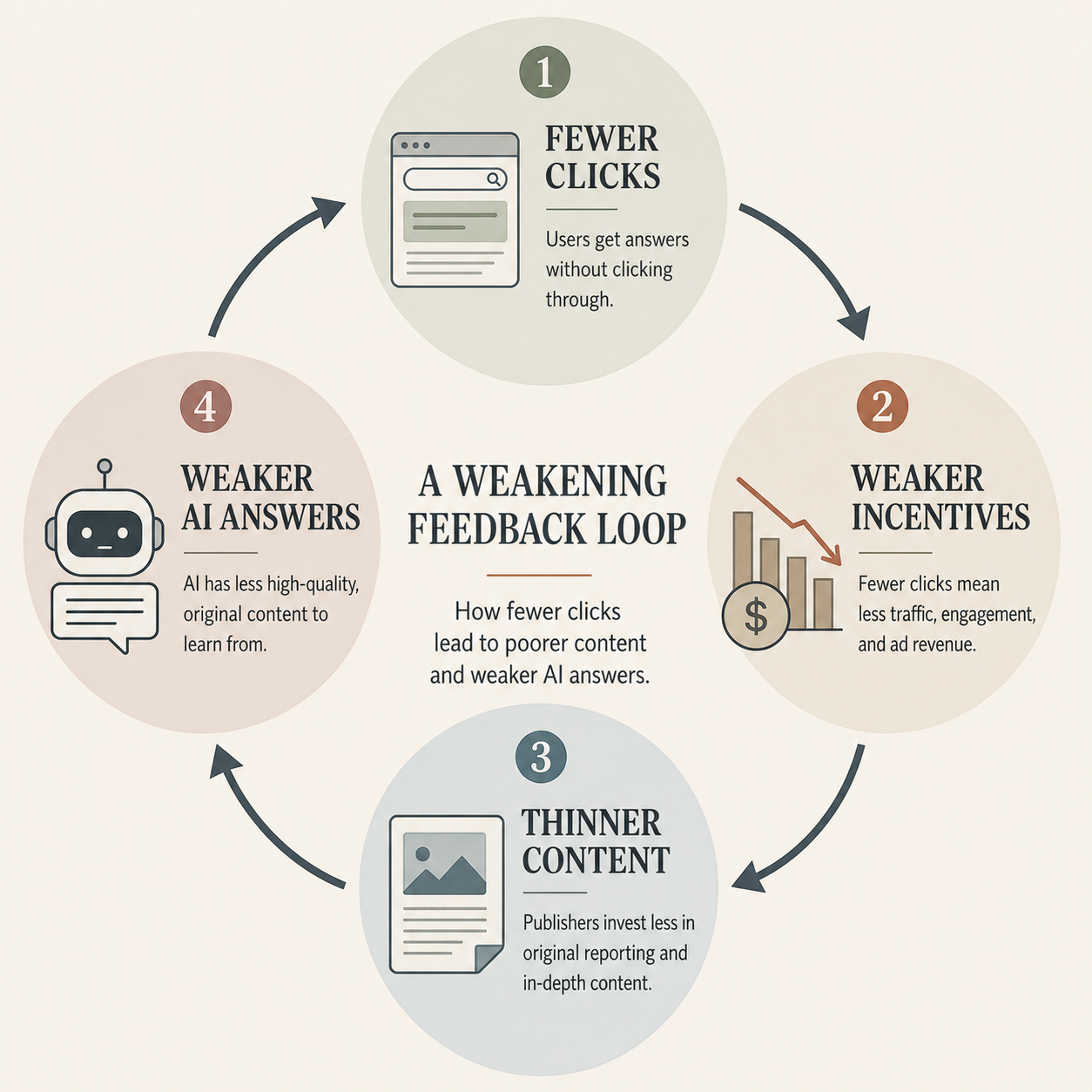
If fewer people visit source websites, creators and publishers lose the incentive to keep producing original, high-effort information. Over time, that can leave AI systems with thinner, older, and lower-quality material to retrieve from.
This creates a compounding loop: fewer visits, fewer incentives to publish, weaker source quality, weaker AI answers, and then even fewer reasons for users to leave the answer layer and verify information directly.
In short, this is not just a technology transition. It is a distribution transition.
Final thought
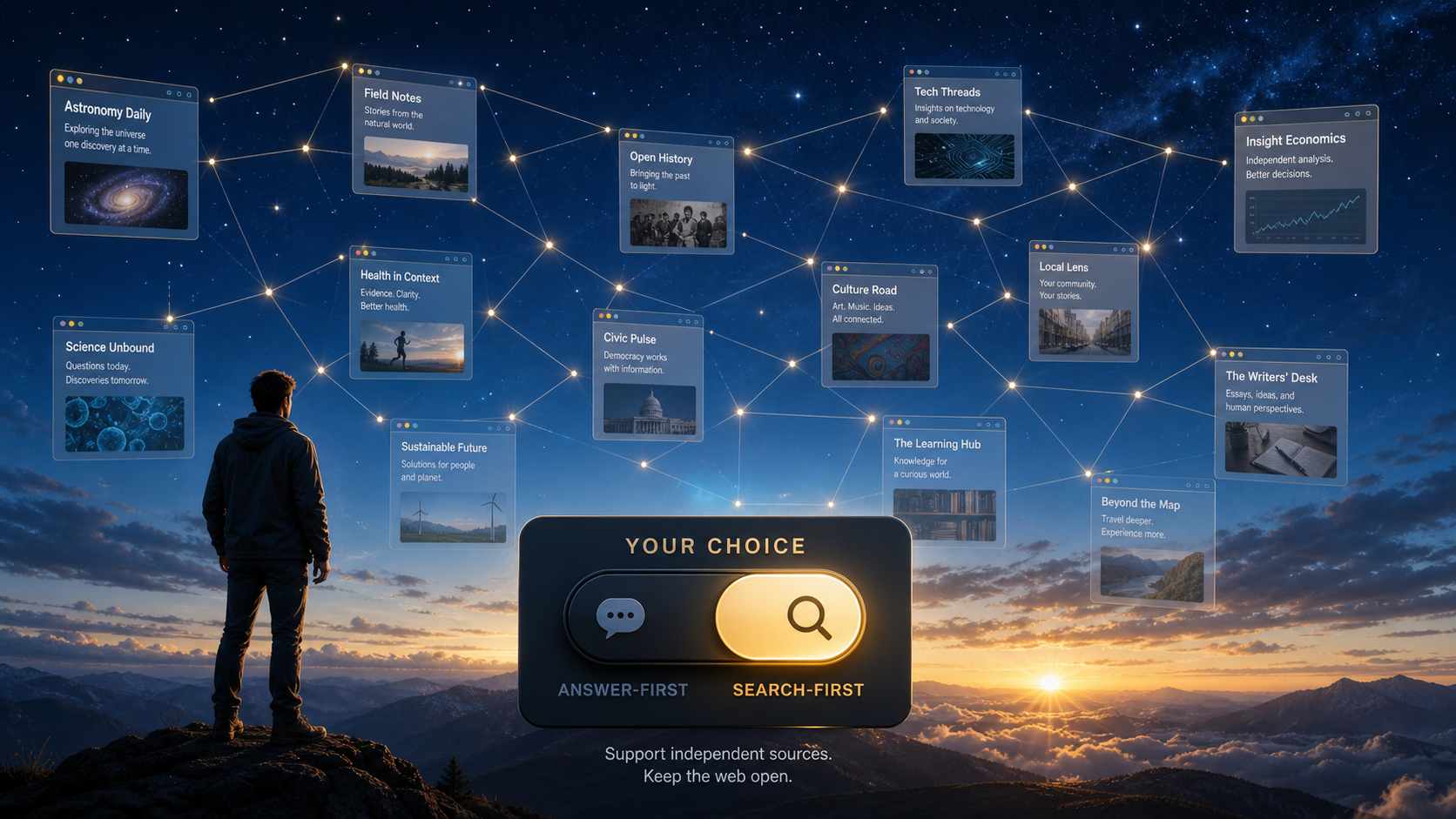
The internet does not become “searchless” in one product launch. It becomes searchless through thousands of small UX decisions that quietly replace exploration with conclusion.
AI answers are here to stay, and they should be. They are useful, efficient, and often impressive. But if answer-first becomes the only practical mode, creators lose discovery, source diversity thins out, and the open web becomes weaker year by year.
The path forward is not anti-AI. It is pro-choice architecture:
- Visible browser and search toggles.
- Frictionless switching between answer mode and search mode.
- Design that rewards source visitation and creator visibility.
Keep AI. Keep search. Keep the web worth creating for.
More reads and trusted sources
If you want to go deeper, these are useful starting points from official product pages, independent research, and technical analysis.
- Google: Expanding AI Overviews and introducing AI Mode
- Google explainer PDF: AI Overviews and AI Mode in Search
- Google Search Help: AI Overviews
- Brave Search: AI in Brave Search
- Brave Search settings: Answer with AI toggle
- Pew Research: Link-click behavior when AI summaries appear
- arXiv: Measuring Google AI Overviews (activation, source quality, claim fidelity, publisher impact)
- arXiv: How generative AI disrupts search (Google Search, Gemini, AI Overviews)
- Similarweb report: The impact of generative AI on publishers
- Cloudflare: Content Independence Day and AI crawl compensation