
The story is made up, the payment is very real
In short: a sponsored Facebook ad from a page called “Elena Popescu” tells the story of a woman who lost more than 25 kilograms by stirring “a little something” into her coffee. The link isn’t in the ad. It’s in a comment written by the page itself, and it leads to an “article” on a site posing as a health publication, Monitorul Sănătății (“The Health Monitor”), and from there to the Slimqa shop, which sells Slim Coffee Booster. I followed the whole path and found three layers: an affiliate who lies to get you to the site, a shop that sells a generic powder at a premium price, and terms and conditions that make getting your money back almost impossible.
The campaign targets Romanian readers, so the quotes below are translated from Romanian.
Table of Contents
The Facebook ad
The ad looks like a personal post. “Elena, 50, from Bucharest” describes how a doctor coldly told her she had “the metabolism of an 80-year-old woman confined to bed”. Two weeks later her colleague Rodica supposedly confided that she had lost “19 kilograms in 11 weeks, without any diet”, just by mixing something into her morning coffee. The story is backed by “a pharmacologist at the University of Bucharest”, with no surname. The ending: “after 12 weeks I had lost more than 25 kilograms”.
The link is in the comments, not in the ad
The ad has no link. Its last line says: “You’ll find the link to the article below, in the comments.” The first comment is written by the “Elena Popescu” page itself, labelled “Author” by Facebook, with the link to coffeeforweight.com.
There’s a reason for this. Facebook reviews the ad text and the page its button points to. A link added later in a comment escapes that review.
Below it, other comments back up the story: one was “extremely sceptical” but now feels the fat “giving way”, another’s husband showed her the article at breakfast. The commenting profiles have AI-generated names and photos, and so is the text of the comments, which follows exactly the roles we also find on the fake page (see “The comments are written into the page” below). The ad had 301 reactions, 102 comments and 20 shares. These fake accounts exist to create interest that isn’t there: lots of reactions and comments tell Facebook’s algorithm the ad is “working”, so it shows it to more people, and readers see that “other women” have already tried it and got results.
Three different promises for the same product
| Where | What it promises |
|---|---|
| The ad text | over 25 kg in 12 weeks |
| The link preview in the comment | over 25 kg in 28 days |
| The “article” on coffeeforweight.com | 12 kg in two weeks |
The numbers don’t match because they don’t come from the same story. They’re pieces of different kits, put together in a hurry.
Who pays for the ad?
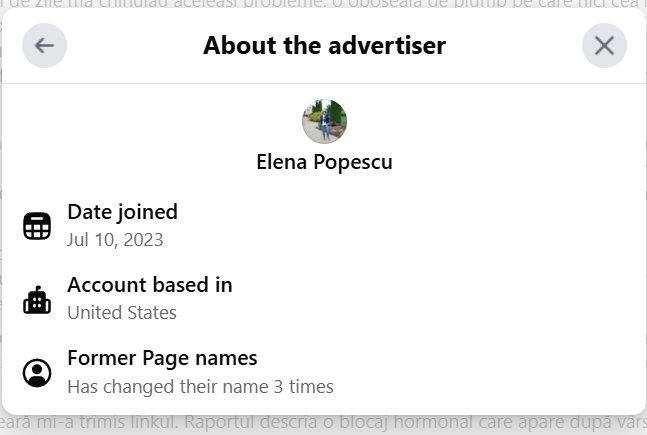
The “About the advertiser” panel, which Facebook shows to anyone, says a lot:
- the name: “Elena Popescu”, one of the most common names in Romania;
- the account is based in the United States, although “Elena” walks down Calea Victoriei in Bucharest;
- the page was created on 10 July 2023 and has changed its name 3 times.
A page that keeps changing its name is usually a bought or recycled page, reused for different campaigns.
For ads shown in the European Union, you can find out more in the Meta Ad Library (facebook.com/ads/library): choose the country, search for the page, open the ad and look for the “Beneficiary and payer” section.
I did exactly that. In the Meta Ad Library (ID 2051900242864978), the ad had been running since 8 October 2026 and, in about 11 hours of activity, had already reached 22,498 accounts in the EU. Under “Advertiser and payer”, the name is neither “Elena Popescu” nor a supplement company, but “Zoe Makeup- Ranchi Makeup Artist”, the page of a make-up artist from Ranchi, India.
A page called “Elena”, run from the United States, paid for under the name of a make-up business in India, selling a slimming coffee to Romanians. The most likely explanation is a hijacked or bought account, used only to pay for the ads. It is a pattern worth remembering: when the page, the country it is run from and the payer don’t match, something is wrong.
The story, step by step
The text follows a pattern we see, almost word for word, in many countries:
- Shame: a doctor gives you a humiliating verdict.
- It’s not your fault: “it’s not a lack of willpower, it’s chemistry”, “a hormonal block after 40”.
- Local details: Bucharest, Calea Victoriei, the Black Sea, Sinaia, the Prahova Valley.
- Someone you know: a colleague who lost weight dramatically.
- The secret: “a biological trigger no doctor had ever explained to me”.
- An authority you can’t check: the pharmacologist with no surname, the endocrinologist who “smiles discreetly”.
- Reassurance: “no hidden subscriptions or other nonsense”, “you have absolutely nothing to lose”.
Traces of machine translation
The Romanian text has errors a native speaker wouldn’t make: a wrong grammatical gender (“o blocaj hormonal”), a holiday “on the coast, at the Black Sea” (a Romanian would just say “at the seaside”), and metaphors that sound odd in Romanian, such as “biological prison”.
The “article”: a publication that doesn’t exist
The link leads to coffeeforweight.com, to a page that imitates a news site: a Monitorul Sănătății logo, a menu, a search box, an author, a date, a reading time, comments. The headline: The “lazy coffee trick” that helped a 52-year-old woman from Ploiești lose 12 kg of fat in just two weeks.
The story doesn’t match the ad. There it was Elena from Bucharest, with a “hormonal block”. Here it’s Maria Popescu from Ploiești, with a wedding in Transylvania and a rude photographer.
If you open the domain’s home page, you get a server error (nginx). There is no website; only the exact address from the comment works. “How they hide from checks” below explains why.
What I found in the page code
A British template, machine-translated
The page wasn’t written for Romania. It’s a UK template, translated in a hurry:
- the folder with the page’s assets is called
Uklulu_files, and comments in the code mention a “BBC/Guardian style”; - a “Romanian doctor” talks about losing “1.5-2.5 stone (9-16 kg)”, a unit of weight used only in the UK;
- a commenter from Romania quotes Davina McCall, a British TV presenter;
- the product was supposedly developed in a laboratory in Cambridge, over 18 months, by “11 British scientists”, from “84 active plants”;
- the “latest news” sidebar has headlines translated from the Independent, the BBC and the Daily Mail;
- the original names survived in the image alt text: “Michelle from Timișoara” is captioned “Mihaela”, and “Linda from Brașov” becomes “Liliana”;
- the author is “Jenny Hughes, health correspondent”, and the profile photos of the “Romanian” commenters are named
RileyTaylor.jpg,IsabelleMartel.jpg,ScarlettMiller.jpg.
The machine translation also shows in the headlines: “THE MOST REVOLUTIONARY DISCovery”, half in capitals, and a heading that leaves the English phrase “in plain sight” untranslated, with the Romanian word for “never” mangled into a word that doesn’t exist (“nicunadă”).
A date that updates itself
The article looks like it was published a few days ago. The date is generated by a script that always shows today’s date minus 5 days. I opened the page on 9 October 2026, and it was “published” on 04.10.2026. In the page code, the real date is 18 January 2025.
The comments are written into the page
The “22 comments” from women in Bucharest, Cluj, Timișoara or Brașov come from no one. They are fixed text in the code, with frozen times (“24 minutes ago”). They are dated 20 April 2026, so the template has been circulating for at least six months.
- the first commenter is also called “Maria Popescu”, like the article’s heroine;
- the comments are written as a dialogue: one is sceptical, another reassures her, another “just ordered”;
- the comment form doesn’t send anything anywhere;
- the footer states that “all comments and statements are from real people”.
The “privacy policy” that gives them away
Clicking “Privacy policy” shows something else: the list of rules an ad network imposes on weight-loss pages, translated into Romanian. The page breaks every one of them:
| Rule from their own “policy” | What the page does |
|---|---|
| Don’t claim losses of 2 kg a week without diet or exercise | Promises 12 kg in 2 weeks, “no gym, no diets” |
| Don’t claim the product works as well as surgery | “SURGICAL-LEVEL SOLUTION”, “liposuction in a box” |
| The doctor shown must be a real person, with cited studies | “Dr. Andrei Ionescu”, with no source |
| Avoid a false sense of urgency | Countdown timer, falling stock, “sells out in HOURS” |
| Don’t mention serious diseases | Red warning about diabetes, heart attack, stroke and cancer |
| Avoid edited before/after images | Before/after images everywhere |
They pasted into the page the very rules they break.
Terms copied from another site
- The terms and conditions belong to another site, pichprokgidads.com, probably left over from an earlier campaign, auto-generated, with a “last updated” date of 13 September 2017.
- The returns policy mentions an “RMA from CDI”, copied from another company’s policy.
- The contact address, hidden in the code, is a Gmail account.
How they hide from checks
Why doesn’t Facebook stop ads like this? Besides the link in the comments, there’s another reason: cloaking, meaning the page shows different content depending on who opens it.
The page’s links have the structure of a traffic tracker (Keitaro-style): a /lander/… address for the landing page and order links with a unique code for every visitor. The tracker decides in real time what you see, based on IP address, country, device and where you came from:
- a reader from Romania, on a phone, coming from Facebook sees the advertorial and the offer;
- a review bot, or someone typing the address directly, sees a harmless page or an error.
That’s why the domain’s home page returns an error. The domain isn’t a website, just a gateway for the tracker.
The quiz where every answer wins
There’s no visible buy button on the article page. Almost every link (the menu, “Log in”, “About us”, “Contact”, even the “Order Slim Coffee Booster” button) is intercepted by a script that sends you back to a quiz: “Answer 3 questions and get UP TO 60% OFF!”.
What the code actually does:
- every answer leads to the same result: “Congratulations! You’ve unlocked 60% OFF!”;
- the 10-minute countdown is decorative; nothing happens when it runs out;
- the stock always starts at 227 packs and drops at random, so it looks as if others are buying right now.
Only after the third question does the one button that leaves the page appear: “Order now with 60% off”. The quiz makes you feel you’ve won something and starts the time pressure.
This is also where the product appears: a SLIMQA Slim Coffee Booster box with all its text in English (“Supports fat burning”, “Food supplement”, “Net wt 60g, 30 sachets”). A supplement sold legally in Romania must have a label in Romanian.
The shop: prices and pressure
The button leads to slimqa.com, to a page for choosing a package.
| Package | Price per box | Total | Extras |
|---|---|---|---|
| 30 days (1 box) | 149 lei | 149 lei + 25 lei delivery | |
| 90 days (3 boxes) | 99 lei | 297 lei | free delivery, “30-day guarantee” |
| 60 days (2 boxes) | 119 lei | 238 lei | free delivery |
(1 euro is roughly 5 lei.)
- The “old price” of 298 lei is the same for every package and never appears as a real price. It’s an invented anchor that makes the discount look huge.
- There is no “60% off” for one box. One box is 50% off. You only get past 60% if you take three. Further down the same page, the promised discount becomes 48%.
- The packages are ordered 30, 90, 60. The most expensive sits in the middle, with “7 out of 10 people choose this package”, “best seller” and “you save 597 lei”.
- The total isn’t shown, only the price per box.
- The “money-back guarantee” appears only on the 3-box package (see “The traps in the terms and conditions”).
- “4.8 stars, over 5,000 members” has no independent platform behind it.
One box holds 60 grams. At 149 lei, that’s about 2,500 lei (around 500 euros) per kilogram of powder.
“Alexandru from Timișoara recently purchased”
While you stay on the page, notifications pop up in the corner: “Alexandru from Timișoara recently purchased a 90-day Slimqa supply, Verified buyer”.
They come from a pre-written list, shown at random intervals. Nobody says who “verified” the buyer, it’s almost always the most expensive package, and the cities are the same as in the fake article.
Test it yourself: stay on the page for a few minutes and write down the names, then open it in incognito mode. If the “buyers” repeat in the same order, they were written in advance.
Who actually sells it
The address that says it all
The offer page address looks like this:
slimqa.com/offer3/ro?affId=blitz&c1=1479&c2=136135798&utm_medium=affiliate&c4=SLIMQA_1479_136135798&sessionId=…utm_medium=affiliate: you came from an affiliate;affId=blitzandc1=1479: the network and the affiliate;c2andsessionId: your click, so the affiliate gets a commission if you pay.
The “Elena Popescu” ad and the “Monitorul Sănătății” page are made by an affiliate, paid per sale. The shop gets customers, the affiliate gets a commission, and if anyone complains about the lies, each can point at the other.
Two companies, neither in Romania
According to the terms on slimqa.com (updated 12 May 2026):
- site operator: Haur B.V., registered in the Netherlands, with an address in Amsterdam;
- seller: Haruki Limited, based in Larnaca, Cyprus;
- both addresses come with a note not to send returns there;
- the applicable law is the law of Cyprus;
- the operator calls itself “solely an intermediary” and leaves the seller full responsibility for the product, including its marketing claims.
Complaints go through an e-mail address and a single online form, “Submit a request”, in English. The Romanian version of the site has no contact page of its own: the link sends you to a version in another language, even if you ordered from a Romanian page.
A second “official site”: slimqa.ro
Besides slimqa.com there is also slimqa.ro, which calls itself the “Official SLIMQA Romania site”:
- the domain was registered on 15 September 2026, less than a month before I wrote this article;
- the real server is hidden behind Cloudflare, so you can’t see where the site is hosted;
- it has the same packages and prices (99, 119 and 149 lei per box, an “old price” of 298 lei), but the promised discount is now “up to 67%”;
- the home page names no company, only an e-mail address. Only the order page has a link to the terms, and it leads back to slimqa.com, to the same Haur B.V. and Haruki Limited;
- that link is an affiliate link: it carries
affId=blitzandutm_medium=affiliate, like the link from the “Elena Popescu” ad, but a different affiliate code (c1=3384instead ofc1=1479).
In other words, the “official site” is just another affiliate sending buyers to the same shop, paid a commission on every sale. When I checked it, none of the 36 security services queried flagged it. That doesn’t make it safe: a new domain simply hasn’t been reported yet.
The same shop, in English: the UK version
The campaign isn’t only aimed at Romania. Slimqa also runs an English version for the United Kingdom, with prices in pounds and the same tricks.
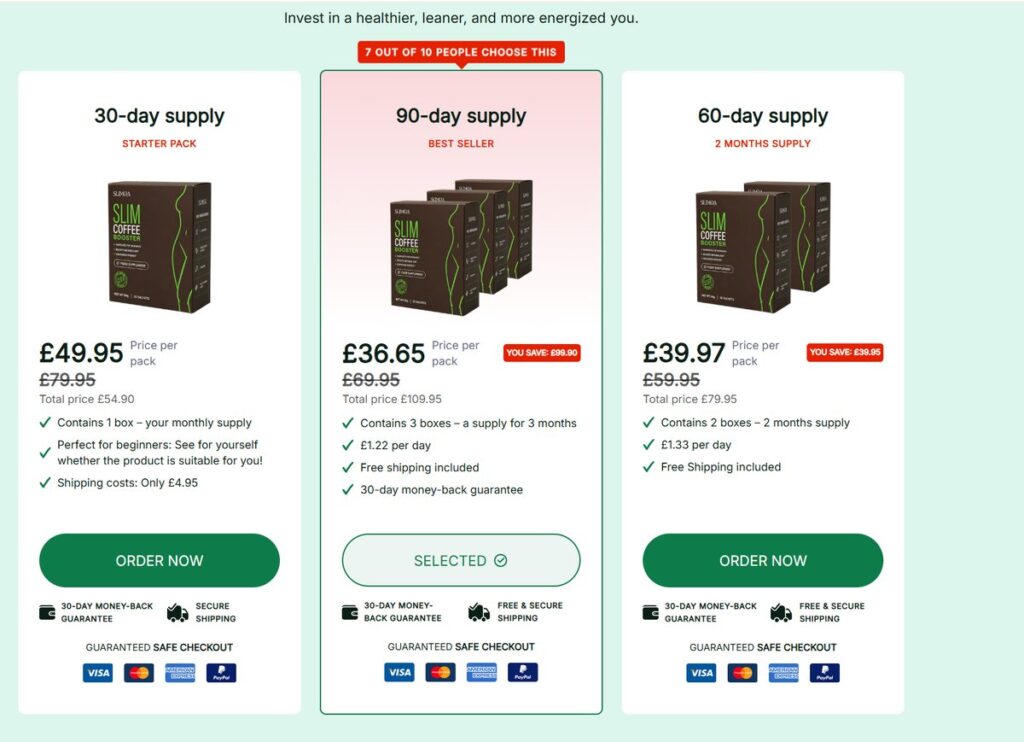
- The same order of packages: 30, 90, 60 days, with the most expensive one in the middle, marked “Best seller” and “7 out of 10 people choose this”.
- The “old price” isn’t even consistent. One box is supposedly reduced from £79.95, a box in the 2-pack from £59.95 and a box in the 3-pack from £69.95. The same product can’t have three different original prices, so the discounts are calculated from invented numbers.
- The real totals: £54.90 for one box with delivery, £79.95 for two and £109.95 for three.
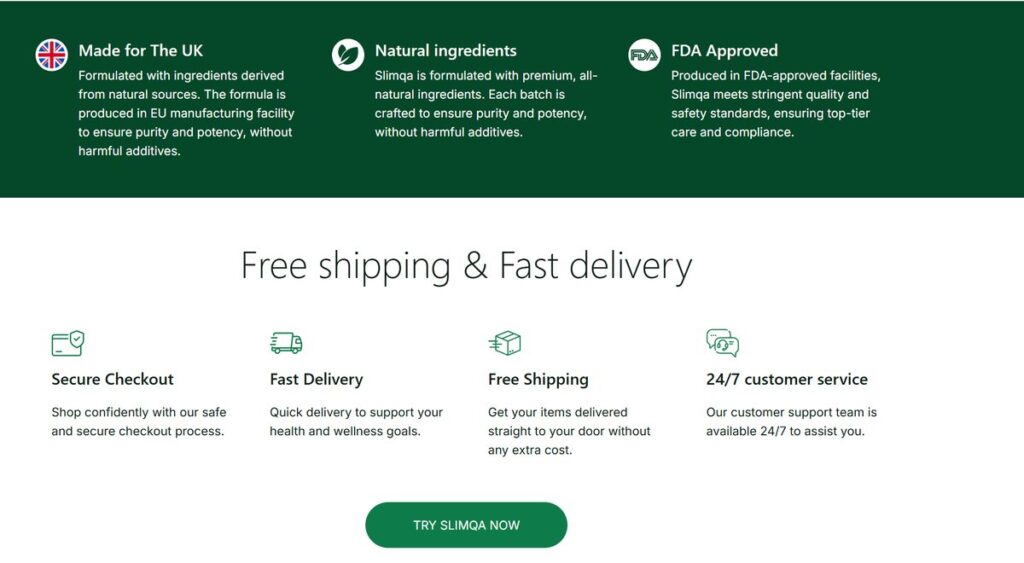
- “Made for The UK”, yet the same paragraph says the formula is produced in an EU facility, while the Romanian site calls itself the “official SLIMQA Romania site”.
- “FDA Approved”, with the FDA logo. The US Food and Drug Administration does not approve food supplements, and it has no say over a product sold in the UK or the EU.
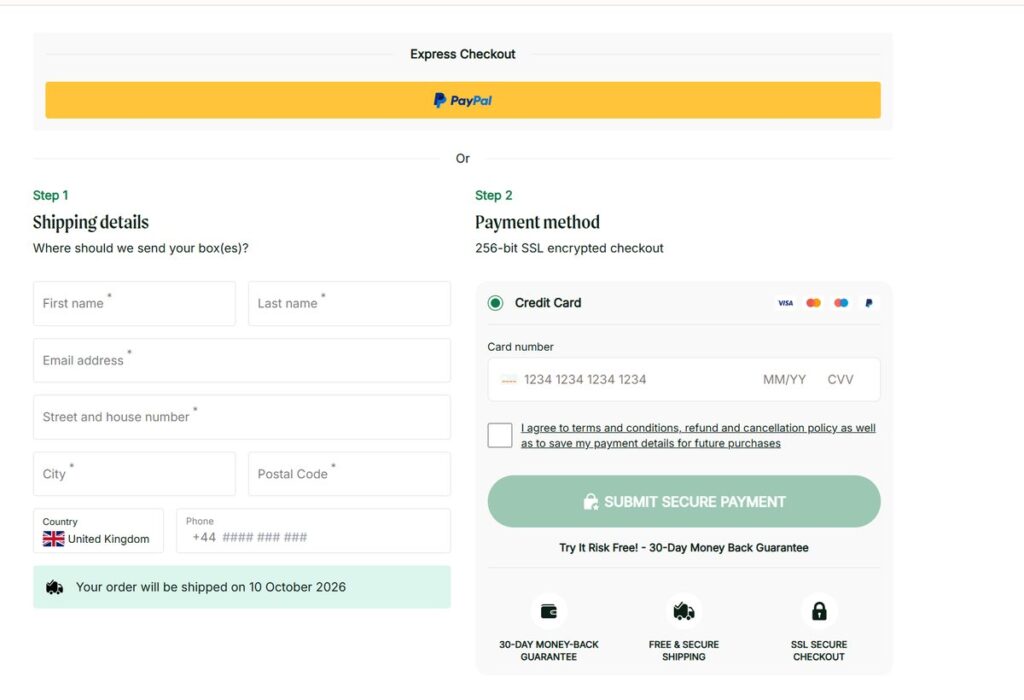
The checkout answers a question I couldn’t answer from the Romanian pages. There is a single checkbox: “I agree to terms and conditions, refund and cancellation policy as well as to save my payment details for future purchases”. You can’t accept the terms without also agreeing that your card is stored, and the terms allow subscriptions, repeated charge attempts and charging other payment methods on your account. The box isn’t ticked in advance, but it bundles two very different consents into one click.
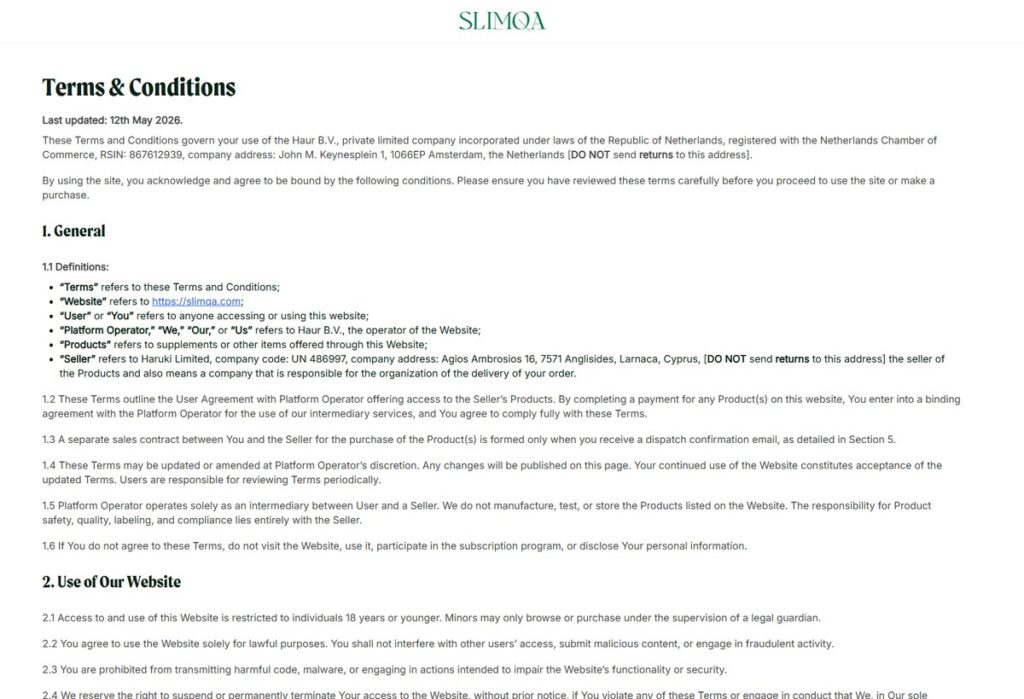
The English terms name the same companies, with registration details: Haur B.V. (RSIN 867612939, Amsterdam) as the platform operator and Haruki Limited (company code UN 486997, Larnaca, Cyprus) as the seller, both with the note “DO NOT send returns to this address”. And a detail that says a lot about how carefully they were written: section 2.1 restricts the website to “individuals 18 years or younger”.
The traps in the terms and conditions
The sales page says in large letters “30-day money-back guarantee”. The terms tell a different story.
A “guarantee” you can’t use
- Refunds apply only to unopened products. You can’t try it and then ask for your money back.
- No refunds for products bought at a discount. On the offer page, every product is presented as discounted.
- You pay for the return, and the original delivery isn’t refunded.
- The returns address isn’t public. You only get it after filling in a form.
- If you refuse the parcel, they can keep up to 150 lei.
- You can cancel an order only within the first hour.
- Checking the return takes 7-14 working days, and the refund another 5-20.
Subscriptions and repeated charges
- subscriptions automatically create new orders until you cancel, at least 48 hours before the next payment;
- if a payment fails, including for an “additional offer”, they can retry the charge for up to 30 days;
- bank fees caused by these retries aren’t their problem;
- if the payment method fails, they can charge any other payment method on the account.
I didn’t place an order, so I can’t confirm whether a subscription starts automatically. The terms allow for one, and the UK checkout ties accepting the terms to saving your card for future purchases. If you ordered, check your bank statements over the following months.
What the law says
In the EU, online purchases generally come with a 14-day right of withdrawal, with an exception for sealed products that can’t be returned for hygiene reasons once unsealed. A rule like “no refunds on discounted products”, when every product is shown as discounted, is hard to defend against a consumer. This isn’t legal advice: for a specific problem, contact the institutions listed under “What you can do”.
What we know about the product
Three ingredient lists
| Where | Ingredients |
|---|---|
| The “Monitorul Sănătății” page | green coffee extract, Garcinia Cambogia, L-carnitine (“84 active plants”) |
| The box in the quiz | L-carnitine, green coffee extract, capsaicin, vitamin blend |
| The slimqa.com shop | ginseng, green tea, cayenne pepper, bitter orange, ginger, apple cider vinegar, cinnamon, berberine, resveratrol, green coffee, chromium, L-carnitine |
Twelve ingredients in 2 grams of powder a day (60 g across 30 sachets) means very small amounts of each. Some, such as bitter orange combined with caffeine, or berberine, can interact with medicines. If you have a heart condition or take regular medication, ask your doctor before trying any supplement like this.
“FDA approved”
The site says the product is made in “FDA-approved facilities”. The US agency does not approve dietary supplements, and for a product sold in Romania, European and Romanian rules are what matter.
What the science says
- caffeine has a small, temporary effect on metabolism and appetite, and regular coffee drinkers get used to it;
- there is no “hormonal block after 40” that stops fat burning; age and menopause change metabolism, but they don’t stop it;
- 12 kg of fat in two weeks or 25 kg in 28 days isn’t plausible without diet or exercise;
- the page’s statistics, such as “199 out of 200 participants”, have no source.
What they admit themselves
- The fake page’s small print says it is “a marketing advertisement, not a news article”.
- The shop’s footer says the health claims have not been scientifically proven or evaluated by doctors.
- The terms say the products have not been evaluated or approved by any authority.
The “reviews”
Searching for “Slimqa Slim Coffee Booster” turns up dozens of “reviews” on free platforms (hackmd.io, Google Sites, Medium, Jimdo), in English and German, with generic text and order links. The same campaign runs in Germany, Austria and Switzerland. The goal: anyone searching for “Slimqa reviews” finds praise, not warnings.
How to spot a fake advertorial
- Who pays for the ad? Tap the page name, then “About the advertiser” or “Page transparency”. An account based in another country, or with several name changes, is a warning sign.
- Is the link in the comments? An ad that sends you “below, in the comments” is usually trying to get around Facebook’s review.
- Does the publication exist? Search for its name separately. A real newspaper has a home page, an archive and an editorial team.
- Does the address match the publication? A “Health Monitor” on coffeeforweight.com isn’t a publication.
- Do the numbers match? If the ad, the link and the article promise different results, the story is made up.
- Results without effort? “No diet, no exercise” is almost always false.
- Does the doctor exist? Search for the full name. If nothing comes up, you have your answer.
- Countdowns, limited stock, quizzes that “unlock” discounts? Pressure techniques, not offers.
- Look at the checkout address.
affId,utm_medium=affiliateorc1=mean you were brought there by an affiliate on commission. - Read the terms before paying. Look for “subscription”, “refund”, “discounted products”, and check who sells and from which country.
- Is the label in your language? In the EU, food supplements must be labelled in the language of the country where they’re sold.
What you can do
If you’ve seen the ad:
- report it: the three dots in the corner of the ad → “Report ad” → “Scam, fraud or false information”;
- tell the people close to you, especially those over 40-50, who are the target of these ads.
If you’ve already ordered:
- check your bank statements for repeated charges or amounts you don’t recognise;
- cancel any subscription from your account on the site or through their form, and keep proof;
- keep the evidence: screenshots of the ad and pages, confirmation e-mails, the parcel tracking number;
- call your bank and ask for a chargeback, especially for unauthorised or repeated charges;
- in Romania, file a complaint with ANPC (anpc.ro), the consumer protection authority;
- because the seller is in Cyprus and the operator in the Netherlands, you can get free help from the European Consumer Centre in your country, which handles disputes with businesses in other EU countries.
Conclusion
“Slim Coffee Booster” isn’t a scientific breakthrough, and Monitorul Sănătății isn’t a publication. From the ad to the shop’s terms, the scheme looks like this:
- A recycled Facebook page, run from the US, publishes an emotional, fake story and puts the link in the comments, where it isn’t reviewed.
- A tracker hides the page from reviewers and shows it only to its targets.
- A machine-translated British template imitates a publication, with a fake date, comments written into the code, invented doctors and a quiz where every answer wins.
- An affiliate paid on commission sends you to the shop.
- A shop run from the Netherlands and Cyprus sells a powder labelled in English, at about 2,500 lei per kilogram, with discounts calculated from an invented price.
- The terms make the guarantee nearly impossible to use and allow subscriptions and repeated charges.
Each link in the chain can say it isn’t responsible for the others. For the buyer, the result is the same: they pay for a promise with no basis, and getting the money back will be hard.
Frequently asked questions
Does Slim Coffee Booster work for weight loss?
There is no evidence that it does. Caffeine has a small, temporary effect on metabolism, and the shop itself says its health claims have not been scientifically proven. Losing 12 kg in two weeks without diet or exercise is not plausible.
Who sells Slim Coffee Booster (Slimqa)?
According to the terms on slimqa.com, the site is operated by Haur B.V., based in Amsterdam, and the seller is Haruki Limited, based in Larnaca, Cyprus. The contract is governed by the law of Cyprus.
Can I get my money back if I ordered?
The terms only allow refunds for unopened products, exclude products bought at a discount, and make you pay for the return. Check your bank statements, cancel any subscription, ask your bank for a chargeback and contact the European Consumer Centre in your country.
How do I spot a fake weight-loss ad on Facebook?
The link is in the comments, the page is run from another country or has changed its name several times, the “publication” does not exist, the results come without effort, and the page uses countdowns, limited stock and quizzes that unlock discounts.
Sources
About the author
Brîndușa Maria, Senior Software Test Analyst, ISTQB® Certified Tester Advanced Level Test Analyst (CTAL-TA). I write about how to recognize online scams. LinkedIn
Note: this article is based on my research and professional experience. I used artificial intelligence tools for drafting and editing.
📢 Share the knowledge, stay safe! 🔒✨ Use the share buttons below and help others stay safe online. The more we know about online scams, the better protected we are! 🚀💙