
Check the course before you reach for your card
In short: a medical AI course (“AI in medicine”) taught through private “tutoring” for 2,500 lei (about 500 euros), with no diploma, no verifiable mentors and no detailed syllabus, is not worth the money. Before paying for any technical course, check who teaches it, what certificate you get, what the syllabus is, what others say and what the refund policy is.
Table of Contents
When I came across an ad for a medical AI course in Romania that promised to teach complex algorithms through “private tutoring” at 250 lei (about 50 euros) per session, my professional radar went off immediately. As a software test analyst, my daily job is to take systems apart and check whether the requirements in the documentation match reality. When I applied the same method to this medical AI course, I found enough red flags for a whole military parade.
Introduction: the AI fever and the risks of no regulation
Over the last three years we have seen an explosion of online courses, medical AI courses included, promising to turn you into an AI expert. The public’s enthusiasm for artificial intelligence is fully justified: AI is changing entire industries, from medicine to finance, from education to transport.
The problem? A total lack of regulation in online technical education.
Today anyone can create a course, throw in buzzwords like “machine learning”, “deep learning” or “the AI revolution”, and charge hundreds or thousands of euros without offering anything concrete in return. Worse, in sensitive fields like medicine, poor quality courses not only empty your wallet, they can create a false sense of competence that can put human lives at risk.
The case
What the course promises
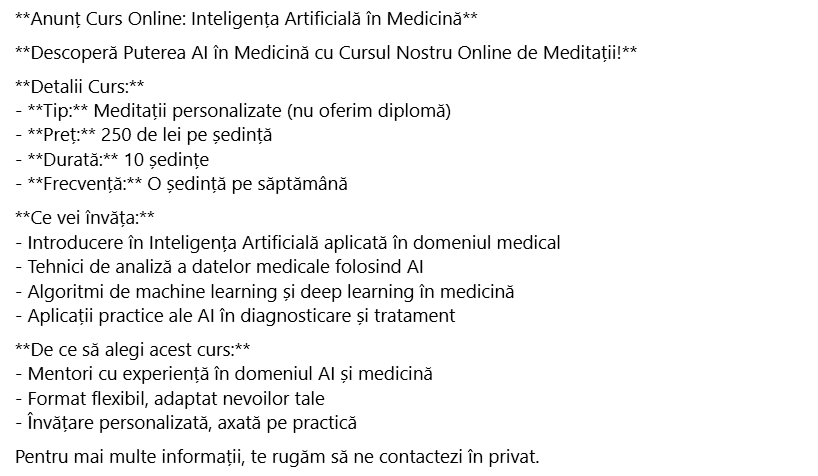
The offer
- Total cost: 2,500 lei (about 500 euros)
- Duration: 10 weeks, one session a week
- Format: “personalized tutoring” (a rather vague term)
- Certificate: none (they state clearly: “we do not offer a diploma”)
- Organizer: a Romanian association in the field
Their marketing messages
“Unlock the power of AI in medicine! […] Revolutionize patient care. Discover how AI can streamline diagnoses, improve treatment plans, and ultimately save lives. […] Become a leader in the exciting field of AI in medicine.”
What they say you will learn
- Introduction to artificial intelligence applied to medicine
- Techniques for analyzing medical data with AI
- Machine learning and deep learning algorithms in medicine
- Practical applications of AI in diagnosis and treatment
First impression: it sounds impressive, right? Let’s test it.
Red flag: an unsuitable teaching format
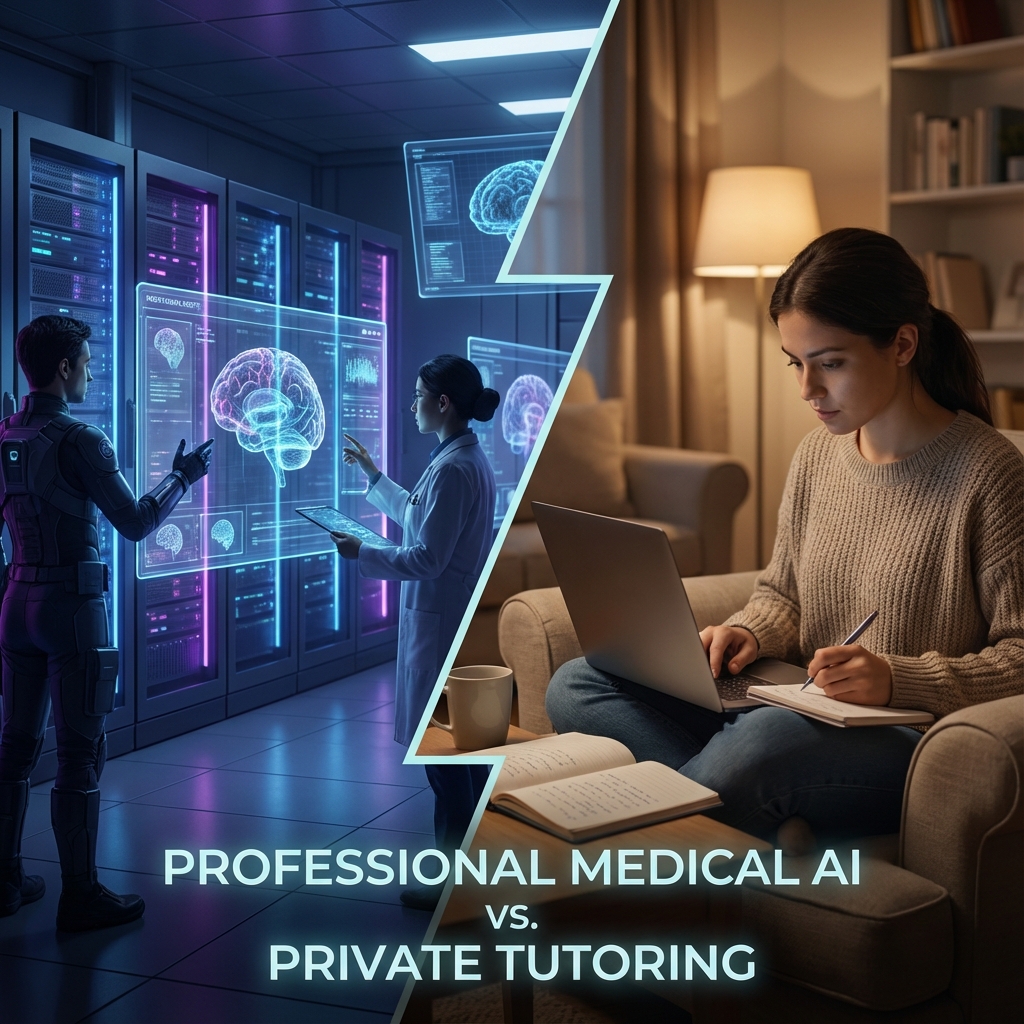
Private tutoring vs academic rigor
The central problem: the medical AI course is structured as “private tutoring”. One-to-one tutoring is excellent for subjects like high school math or learning a foreign language, but medical AI is a discipline that needs solid academic and technical infrastructure, not just private conversations.
Why?
Medical AI is an EXTREMELY technical discipline:
- It requires a solid grounding in statistics and probability
- It requires programming skills (Python, R or at least SQL)
- It requires a deep understanding of bioinformatics and medical databases
- It involves complex algorithms (neural networks, CNNs for imaging)
- It needs access to computing power (GPUs) and professional development environments
- It needs access to massive medical datasets, which cannot be handled in a “private session”
The private tutoring format is:
- Limited to the perspective of a single mentor
- Missing any peer review or academic validation
- Unsuitable for large projects that need collaboration and infrastructure
My analogy: it is like trying to learn neurosurgery through private lessons at home. However good the teacher, you need a university, specialized labs, a hospital and a whole team of specialists to really learn the profession.
The critical question
If you want to learn machine learning and deep learning applied to medicine, how can you do it without access to a technical lab and an accredited learning platform?
The likely answer: the word “tutoring” is used to hide the lack of a standardized syllabus and real technical support. Instead of a structured course, you risk paying for casual conversations that will not help you build real systems. In Romanian, the word used in the ad (“meditații”) also means “meditation”, so it can easily be confused with mindfulness, which makes an offer that claims to be technical look even less serious.
The REAL risk: someone who believes that after 10 hours of private “tutoring” they can make decisions in a medical diagnostic system puts patients in danger. Medical AI is not a hobby, it is a critical discipline.
Red flag: price versus value
A short economic analysis
Cost: 2,500 lei (about 500 euros) for 10 sessions
What you (do not) get for that money:
- No diploma or certificate
- No continuing medical education credits
- No access to real technical infrastructure (servers, GPUs for training models)
- No real medical datasets to work on
- “Personalized tutoring”: a promise with no clear definition
Comparison with serious alternatives
| Criteria | “Private tutoring” | Coursera (DeepLearning.AI) | Fast.ai |
|---|---|---|---|
| Price | 2,500 lei | Monthly subscription | Free |
| Certificate | ❌ No | ✅ DeepLearning.AI | ❌ No (portfolio based) |
| Practical projects | ❓ Unclear | ✅ Yes | ✅ Yes |
| High caliber mentors | ❌ No | ✅ DeepLearning.AI | ✅ Jeremy Howard |
| Real datasets | ❓ Unclear | ✅ Yes | ✅ Yes (Kaggle) |
| Community and support | ❓ Unclear | ✅ Active forum | ✅ Very active forum |
| Industry recognition | ❌ Zero | ✅ Excellent | ✅ Very good |
Conclusion: you pay much more than for an internationally recognized course, for a course with no certificate, no verifiable mentors and a completely unsuitable teaching format (private tutoring instead of academic rigor).
Red flag: dangerous promises
The bombastic messages
“Revolutionize patient care”
“Optimize diagnosis”
“Improve treatment plans”
“Save lives”
The problem: promises like these, from a medical AI course without accreditation, are not just unrealistic, they are downright irresponsible.
Why do I say that?
No accreditation means no legal competence
For software that helps with diagnosis or works with medical data in hospitals, you usually need much more than a “relaxation course”:
- Rigorous certifications (for example ISO standards specific to medical software)
- Approvals from regulatory authorities (such as the national medicines and medical devices agency)
- Medical studies or very close collaboration with licensed doctors
A course with no diploma or official recognition will never give you the legal right to “improve treatment plans”.
A wrong medical algorithm can be fatal
Real examples:
- IBM Watson for Oncology: although it promised a revolution, it was criticized for unsafe treatment recommendations and was abandoned by several hospitals.
- Diagnostic errors: algorithms trained only on certain groups of patients gave disastrous results for others.
- Screening errors: a weak model can miss an early cancer diagnosis, losing the critical moment for treatment.
The “I know everything” trap (the Dunning-Kruger effect)
The biggest danger is that someone who took a few private “tutoring” sessions on AI may believe they have the necessary skills:
- They start building systems without understanding the risks
- They seriously overestimate their technical knowledge
- They put people’s health at risk out of ignorance, not ill will
A simple example: “I took the course, I know everything about neural networks, I can build a diagnostic system for X-rays on my own!”
The reality: you need years of experience processing medical data, you need to understand the distortions of the machines, work side by side with radiologists and follow extremely strict clinical validation protocols before your system ever touches a real patient.
Red flag: a total lack of transparency
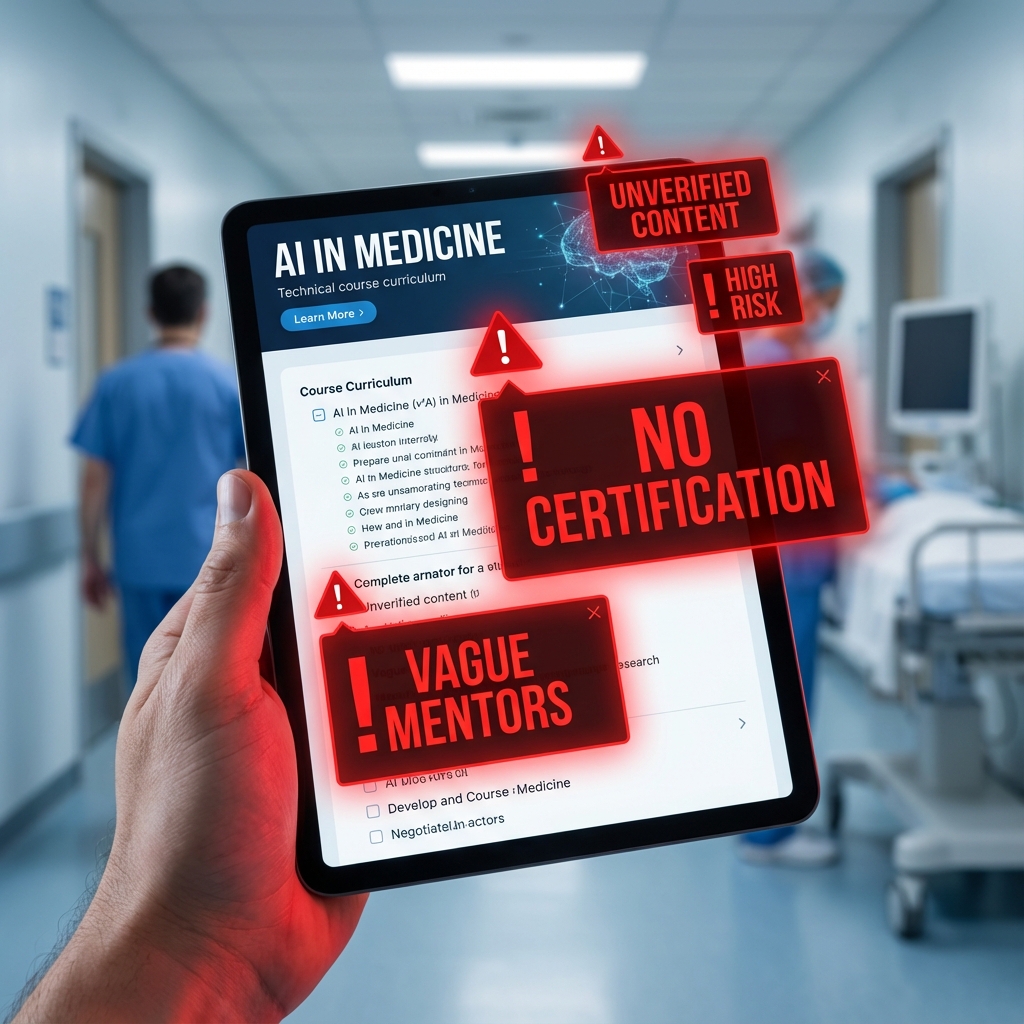
What is missing from their ad
When I evaluate a technical course, I look for certain key information. Here it is completely missing:
Who the mentors are
What a serious offer should look like:
- Full names and public profiles
- CVs that can be verified
- Links to LinkedIn or scientific publications
- Demonstrable practical experience
What we have here: “Mentors with experience in AI and medicine”: a description that cannot be verified in any way.
A detailed syllabus (curriculum)
What you should get: a clear list of what is taught in each session, what software tools you will use, what datasets you will work on and what final project you will build.
What we have here: descriptions so general that they say nothing (“Introduction to AI”, “Analysis techniques”).
Is the organizer legitimate?
My quick tests:
- Google search: almost no results, no clear official website.
- Members and leadership: who are the people behind the association? Zero transparency.
How to check a company, see the article about fraudulent websites.
Course samples or demos
They ask for 2,500 lei without showing you even one minute of the medical AI course or a sample of study material. It is like buying a car without even starting it.
The ad has a detail you notice right away: the text contains markdown asterisks (for example “**Price:**”). That is what text copied straight from a chatbot looks like, without anyone responsible for it reading it again or tidying it up.
Conclusion: when a technical course hides the details, it is usually because it has nothing to show.
Checklist: how to analyze any medical AI course
I created a simple framework you can use to evaluate any course, whether it is about AI, programming or cybersecurity.
10 questions to ask before you reach for your card
Who teaches it, and what experience do they have?
What to look for: full name, a LinkedIn profile with real experience, possibly projects on GitHub or scientific publications.
Red flag: “anonymous experts” or a refusal to give names before payment.
Is there a detailed syllabus?
What to look for: a complete week-by-week syllabus, with the tools and programming languages used.
Red flag: vague descriptions like “find out everything in the course”.
What certificate do you get, and who recognizes it?
What to look for: certificates from accredited universities or professional accreditations recognized by the industry.
Red flag: promises of complex skills without any official recognition.
Are there real testimonials?
What to look for: reviews on independent platforms, or graduates you can contact on LinkedIn.
Red flag: only anonymous quotes on their own website.
Can I see a sample of the course?
What to look for: a demo video, a free trial lesson or a clear money-back guarantee.
Red flag: zero access to materials before payment.
Value for money compared with the alternatives
What to do: compare the price with courses on Coursera, edX or Udemy. If it is 5 times more expensive without a clear reason (for example real one-to-one mentoring), that is a problem.
Practical projects on real data
What to look for: concrete projects you can add to your portfolio.
Red flag: theory only, or “free discussions”.
Is the organizer a legitimate entity?
What to look for: a university, a well known company or an association with a solid website.
What support do you get after the course?
What to look for: access to alumni communities or to the course materials in the long term.
The refund policy
What to look for: a transparent policy that lets you ask for your money back if the course is not what was promised.
Red flag: “No refunds under any circumstances”.
Serious alternatives for learning medical AI
If you really want to learn how AI is applied in medicine, here are some options worth your time:
Beginner level
Coursera: AI for Medicine Specialization (DeepLearning.AI)
- Price: monthly subscription, see the current price on the course page.
- Certificate: DeepLearning.AI, through Coursera.
- Content: 3 courses focused on diagnosis, prognosis and treatment.
- Practice: you work directly in Jupyter notebooks with real medical datasets.
Harvard T.H. Chan School of Public Health: AI in Health Care Certificate of Specialization
- Format: a 3-course certificate of specialization, offered by the Harvard Chan Advanced Learning Academy.
- Price: there is no single price; each course is paid separately.
Intermediate level
Fast.ai: Practical Deep Learning for Coders
- Price: FREE, open source.
- Content: deep learning taught from scratch, directly applicable to medical imaging.
- Practice: real projects and Kaggle competitions.
- Community: one of the most active in the world.
Kaggle competitions: medical imaging
- Price: FREE.
- Examples: detecting pneumonia or diabetic retinopathy.
- Portfolio: your participation history is the best proof of your skills.
Quick cost comparison
| Option | Estimated price | Certificate | Recognition |
|---|---|---|---|
| “The private course” | 2,500 lei | ❌ No | ❌ Zero |
| Coursera | Monthly subscription | ✅ DeepLearning.AI | ✅ Excellent |
| Harvard Chan | Per course | ✅ Harvard Chan | ✅ Excellent |
| Fast.ai | Free | Portfolio projects | ✅ Very good |
What's new in 2026
The rules for AI in health come later, but they are coming (June 2026)
On 29 June 2026, the Council of the European Union gave final approval to the “Digital Omnibus” package, which postpones the application of rules in the EU Artificial Intelligence Act (AI Act). For stand-alone high-risk AI systems, the new deadline is 2 December 2027. For those built into regulated products, such as medical devices, the deadline is 2 August 2028.
The deadlines moved, but the direction stays the same: an AI system used in healthcare has to be proven and verified, not just “learned in tutoring sessions”.
Conclusion: what this case teaches us

After my analysis, this course ticks too many problem boxes to be taken seriously. I see it either as an attempt at quick profit on the back of AI enthusiasm, or as a serious lack of professionalism. In both scenarios: I do not recommend it.
The lesson
This case is not the only one. The world of online courses is full of shiny promises with no substance. The same pattern appears in trading platform scams and in the courses sold through MLM schemes. As “testers” of our own education, we have a responsibility:
- to check before we pay;
- to ask for full transparency;
- to always compare with established options.
Frequently asked questions
Is an AI in medicine course without a diploma worth the money?
Usually not. In medicine, a course with no diploma, no syllabus and no verifiable mentors gives you no right to work with medical data or diagnostic systems.
What does “private tutoring” mean for a technical course?
Individual lessons, with no standardized syllabus and no access to technical infrastructure. That works for high school math or a foreign language, but not for a field that needs data, computing power and validation.
How do I check an online course before paying?
Check who teaches it (full name, verifiable profile), what certificate you get, whether there is a detailed syllabus and a course sample, what graduates say outside the course website, and what the refund policy is.
Can I learn medical AI for free?
Yes, partly. Fast.ai is free, Kaggle competitions are free, and many university courses can be followed without a certificate, in audit mode.
Sources
- Coursera: AI for Medicine Specialization (DeepLearning.AI)
- Harvard T.H. Chan: AI in Health Care Certificate of Specialization
- fast.ai: Practical Deep Learning for Coders
- Kaggle: competitions
- Council of the EU: Artificial Intelligence: Council gives final green light to simplify and streamline rules (29 June 2026)
- European Commission: AI Omnibus enters into force
About the author
Brîndușa Maria, Senior Software Test Analyst, ISTQB® Certified Tester Advanced Level Test Analyst (CTAL-TA). I write about how to recognize online scams. LinkedIn
Note: this article is based on my research and professional experience. I used artificial intelligence tools for drafting and editing.
📢 Share the knowledge, stay safe! 🔒✨ Use the share buttons below and help others stay safe online. The more we know about online scams, the better protected we are! 🚀💙